


Teradata Database Dynamic Account
Overview
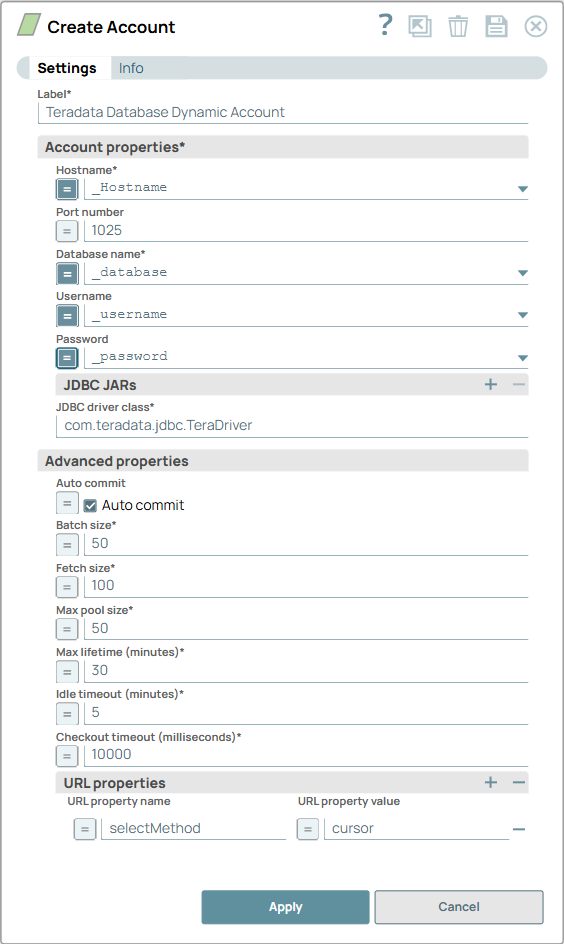
Expression-enabled authentication fields such as Username and Password support Secrets Management, a SnapLogic add-on that stores endpoint credentials in a third-party secrets manager such as AWS Secrets Manager, Azure Key Vault, or HashiCorp Vault. Pipelines obtain credentials directly from the secrets manager during validation and execution. Learn more: Configure Accounts to use secrets.
Prerequisites
- A running Teradata database server.
- Valid Teradata database credentials (username and password).
Account settings
- Expression icon (
 ): Allows using
JavaScript syntax to access SnapLogic Expressions to set field values dynamically (if
enabled). If disabled, you can provide a static value. Learn more.
): Allows using
JavaScript syntax to access SnapLogic Expressions to set field values dynamically (if
enabled). If disabled, you can provide a static value. Learn more. - SnapGPT (
 ): Generates SnapLogic Expressions
based on natural language using SnapGPT. Learn
more.
): Generates SnapLogic Expressions
based on natural language using SnapGPT. Learn
more. - Suggestion icon (
 ): Populates a
list of values dynamically based on your Snap configuration. You can select only one
attribute at a time using the icon. Type into the field if it supports a comma-separated
list of values.
): Populates a
list of values dynamically based on your Snap configuration. You can select only one
attribute at a time using the icon. Type into the field if it supports a comma-separated
list of values. - Upload
 : Uploads files. Learn more.
| Field/Field set | Description |
|---|---|
Label*String |
Required.Specify a unique label for the account. Default value: N/A Example: Teradata dynamic account |
Account propertiesFieldset |
Connection settings for the Teradata database. |
HostnameString/Expression |
Required. Specify the hostname or IP address of the Teradata database server. Default value: N/A Example: teradata.example.com |
Port numberString/Expression |
Specify the port of the Teradata database server. Specifying a port may cause the address to be parsed as an IPv6 address; use with care. Default value: N/A Example: 1025 |
Database nameString/Expression |
Required. Specify the name of the Teradata database to connect to. Default value: N/A Example: sales_db |
UsernameString/Expression |
Required. Specify the username to use when connecting to the database. Used as the default username when retrieving connections. Supports expression mode for dynamic or secrets-managed values. Default value: N/A Example: td_user |
PasswordString/Expression |
Specify the password for the database connection. Used as the default password when retrieving connections. Supports expression mode for dynamic or secrets-managed values. Default value: N/A Example: Encrypted |
JDBC jarsString/Expression |
Specify any JDBC JAR files to load. Each driver binary must have a unique name. If left blank, the default JDBC driver is loaded. Default value: N/A |
JDBC driver classString/Expression |
Required. Specify the JDBC driver class name to use. Default value: |
Advanced propertiesFieldset |
Connection pool settings for managing Teradata database connections. |
Auto commitCheckbox |
When selected, each batch is committed immediately after execution. If the Snap fails, only the batch in progress is rolled back. When deselected, output is committed only after all batches complete; if the Snap fails, the entire transaction is rolled back. Default value: Selected |
Batch sizeInteger/Expression |
Required. Specify the number of statements to execute at a time. Select queries are not batched. Large values may exceed the JDBC placeholder limit of 2100. Default value: 50 Example: 100 |
Fetch sizeInteger/Expression |
Required. Specify the number of rows to fetch at a time when executing a query. Large values could cause the server to run out of memory. Default value: 100 Example: 500 |
Max pool sizeInteger/Expression |
Required. Specify the maximum number of connections the pool maintains at a time. Default value: 50 Example: 100 |
Max life timeInteger/Expression |
Required. Specify the maximum lifetime (in minutes) of a connection in the pool. Set this value a few seconds shorter than any database or infrastructure-imposed connection time limit. A value of 0 indicates an infinite lifetime, subject to the Idle Timeout setting. In-use connections are never retired; connections are removed only after they are closed. Default value: 30 Example: 60 |
Idle timeoutInteger/Expression |
Required. Specify the maximum time (in minutes) a connection may sit idle in the pool. A value of 0 means idle connections are never removed from the pool. Default value: 5 Example: 10 |
Checkout timeoutInteger/Expression |
Required. Specify the number of milliseconds to wait for a connection when the pool is exhausted. A value of 0 causes the Snap to wait indefinitely; SnapLogic recommends not setting this to 0. Default value: 10000 Example: 5000 |
URL propertiesFieldset |
Additional JDBC URL connection properties specified as name-value pairs. |
URL property nameString/Expression |
Specify additional JDBC URL property name. Example: |
URL property valueString/Expression |
Specify the value for the property name. Example: |