


Delete a project or project space
DELETE https://{controlplane_path}/api/1/rest/public/assetapi/project/{project_or_space_path} Overview
This API moves an existing project or project space to the Recycle Bin. Items in the Recycle Bin are purged after a 30-day grace period.
- All Tasks in it are disabled.
- All Snaplexes in it are permanently deleted.
- You must add Snaplexes again.
- You must enable the Tasks again and associate them with the appropriate Snaplexes.
Prerequisites
- Environment (Org) admin permissions or Full Access permissions to the project or project space
Path parameters
| Key | Description |
|---|---|
controlplane_path |
Required. The SnapLogic control plane host:
elastic.snaplogic.com (US) or
emea.snaplogic.com (EU). |
project_or_space_path |
The path to the SnapLogic project or project space.
Format:
Default:
Important: The path comparison is case-sensitive.
|
Query parameters
None.
Request header
Basic authentication
To use basic authentication, specify Basic for authorization in the request
header, add your credentials (email and password for your SnapLogic user or service account), and
specify application/json for content type. For example:
Authorization: Basic {base64_encoded <email>:<password>}
Content-Type: application/json
Example of basic authentication using Postman:
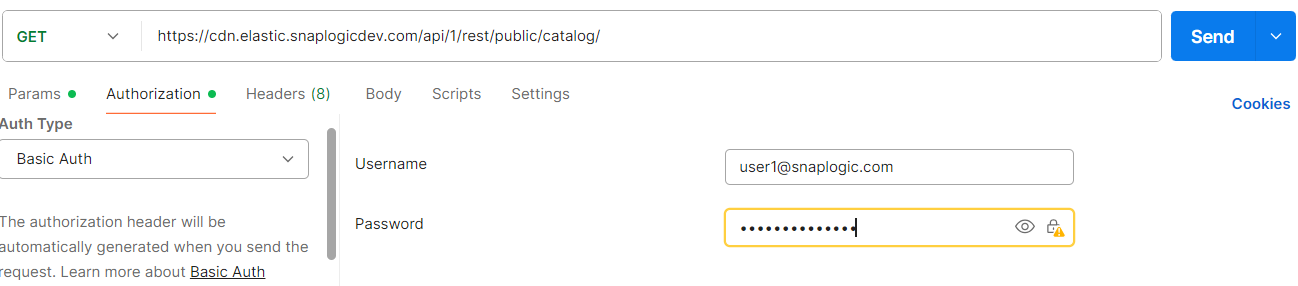
Learn more about the basic authentication header in REST API requests.
JWT authentication
When using JWT authentication, the API request includes specific headers. In the request header,
specify Bearer Token for authorization, add the token, and specify
application/json for content type. These headers are automatically added when
you configure bearer token authentication in your API client. The authorization header contains
the word Bearer followed by a space and your JWT.
Authorization: Bearer Token {token}
Content-Type: application/json
Example of JWT authentication using Postman:
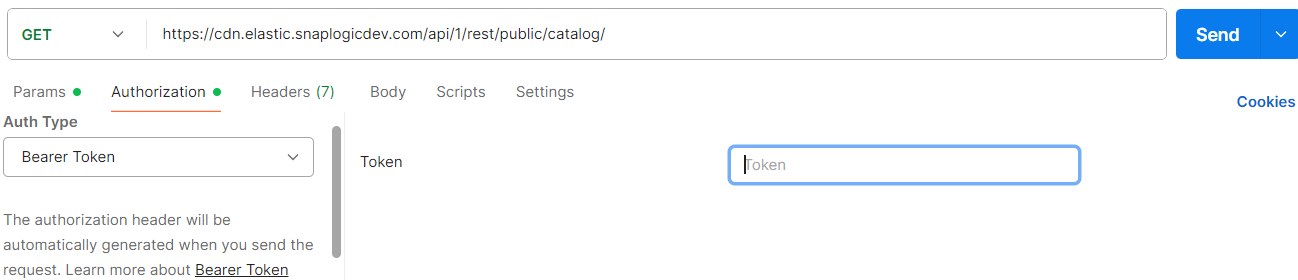
Request body
None.
Response
{
    "response_map": {},
    "http_status_code": 200
}