


Session timeouts
Configure how long users stay logged in.
A session begins when a user logs in to a SnapLogic application and ends when the session times out or the user logs out. When a session expires, the user must log in again. Environment admins can configure session and idle timeouts from the Security section of the left navigation pane:
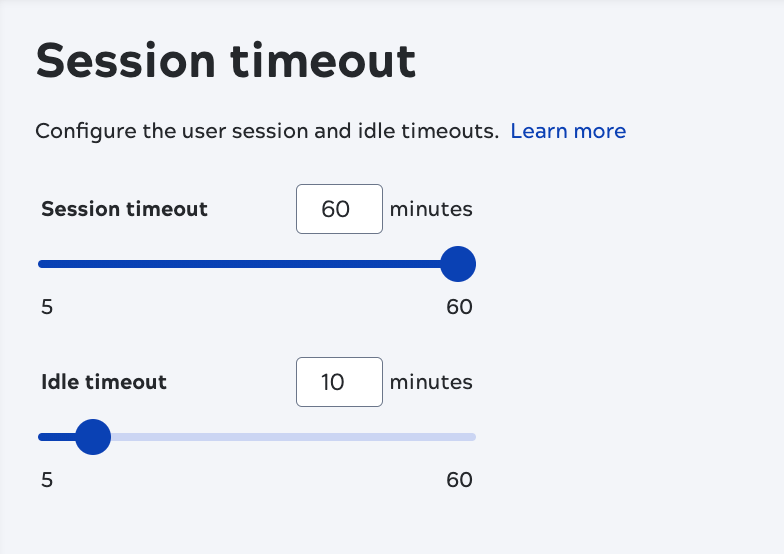
A timeout value can be between 5 and 60 minutes. The default for both values is 60 minutes. The Open Web Application Security Project (OWASP) recommends 2–5 minutes for high-value applications and 15–30 minutes for low-risk applications; since this page's minimum is 5 minutes, use the lowest value the page allows (5 minutes) for high-value applications. Choose a value that balances your security requirements with user productivity.
Enter a value or use the sliders to set:
- Session timeout: The maximum duration a user session can remain active. Regardless of ongoing activity, the system automatically logs users out this many minutes after login, without providing a warning before session termination.
- Idle timeout: The maximum amount of time a user can remain
inactive—without any mouse, keyboard, scroll, or touch input—before the system
automatically logs them out. This idle timeout is measured in minutes.
- A warning dialog appears 2 minutes before logout, giving users a chance to click Continue to stay logged in. For example, setting Idle timeout to 5 minutes means the dialog appears at 3 minutes of inactivity.
- Activity in any open SnapLogic tab resets the idle timer.
Click Save to apply your changes.
Multi Environment/Org user sessions
If a user has access to multiple Environments/Orgs, the user session token expiration and idle timeout are determined by the shortest duration among all Environments to which the user has access. For example, if a user has access to an Environment with a 60-minute timeout and another Environment configured with a 15-minute timeout, the user's session expires after 15 minutes regardless of which Environment is currently active in the UI.
How Multi-Environment/Org session timeout works?
During login, the SnapLogic Platform issues an authentication session token before an active Environment is selected. Because users can switch between Environments during an active session, the platform enforces the most restrictive timeout setting to maintain consistent security policies across all associated Environments.
To avoid unexpected session terminations for shared user accounts:
-
Align timeout durations: Coordinate settings across development, test, and production Environment to ensure uniform session and idle timeout values.
-
Review user Environment access: If users report premature session expirations, inspect the timeout parameters across all Environments where the user maintains active membership.