


Check out project files
POST https://{controlplane_path}/api/1/rest/public/project/checkout/{project_path} Overview
Checks out the specified Git branch for the specified project. Equivalent to git checkout.
- The project must already exist.
- You can track up to 1,000 files in each project, including every tracked asset and any other files in the project's folder in the repository. In a project space, each project has its own limit. Each file can be up to 50 MB. A commit, checkout, or pull that exceeds either limit fails with an error.
Prerequisites
- Write access to the assets to be added or updated
Limitations
- You cannot use SnapLogic service accounts to call any of the SnapLogic Git operation APIs.
Request
POST https://{controlplane_path}/api/1/rest/public/project/checkout/{project_path}
Path parameters
| Key | Description |
|---|---|
controlplane_path |
Required. The SnapLogic control plane host:
elastic.snaplogic.com (US) or
emea.snaplogic.com (EU). |
project_path |
Required.
The path to the SnapLogic project.
Format:
Important: The path comparison is case-sensitive.
|
Query parameters
None.
Request header
Basic authentication
To use basic authentication, specify Basic for authorization in the request
header, add your credentials (email and password for your SnapLogic user or service account), and
specify application/json for content type. For example:
Authorization: Basic {base64_encoded <email>:<password>}
Content-Type: application/json
Example of basic authentication using Postman:
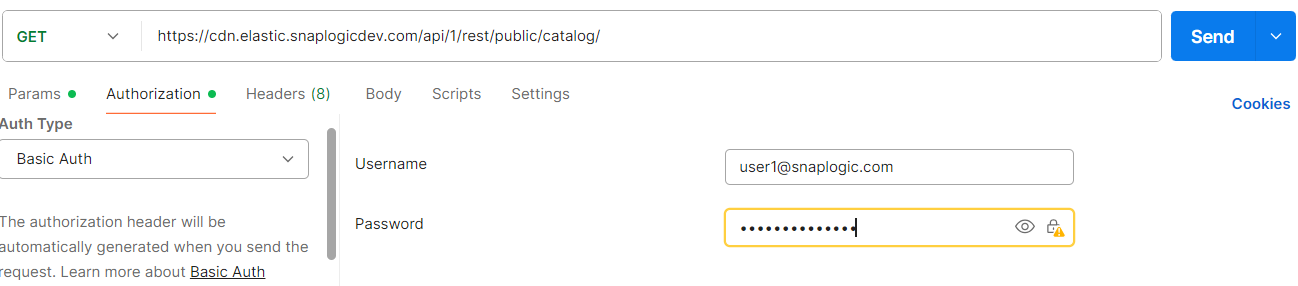
Learn more about the basic authentication header in REST API requests.
JWT authentication
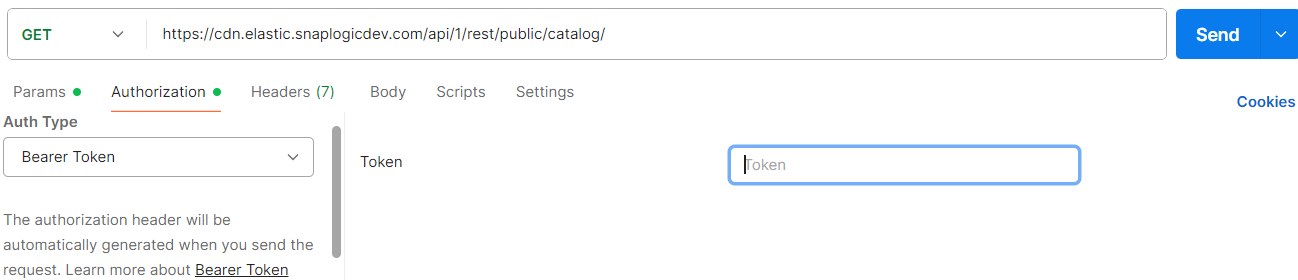
When using JWT authentication, the API request includes specific headers. In the request header,
specify Bearer Token for authorization, add the token, and specify
application/json for content type. These headers are automatically added when
you configure bearer token authentication in your API client. The authorization header contains
the word Bearer followed by a space and your JWT.
Authorization: Bearer Token {token}
Content-Type: application/json
Example of JWT authentication using Postman:
Request body
 {
  "repo" : "git_repository",
  "ref" : "branch_name",
  "hard_reset" : true,
  "discard_untracked_file" : true
}
| Key | Type | Description |
|---|---|---|
repo |
string | The Git repository to check out. If not specified, the repository that was previously associated with the project is used.
Default: None |
ref |
string | Required. The Git branch to check out.
Default: |
hard_reset |
Boolean | If true, modified assets are discarded and new assets are force-pulled from the repository.
Default: False |
discard_untracked_file |
Boolean | If true, untracked assets are discarded.
Default: False |
Response
 {
  "response_map": {
    "status": "",
    "overwritten": [ ... ],
    "updated": [ ... ],
    "error_msgs": [ ... ],
    "created": [ ... ],
    "ignored": [ ... ]
  },
  "http_status_code": 200
}
| Key | Type | Description |
|---|---|---|
status |
string | The status of the process. |
overwritten |
array | The list of files that were overwritten. |
updated |
array | The list of files that were updated. |
error_msgs |
array | Any error messages that were thrown during the process. |
created |
array | Asset files that were copied from the Git repository into the project. |
ignored |
array | Asset files that exist in the Git repository but were not copied into the project. |
Example
This example uses Basic authentication. For a JWT example, refer to Authentication.
curl -X POST \
  'https://elastic.snaplogic.com/api/1/rest/public/project/checkout/acme/MySpace/MyProject' \
  -H 'Authorization: Basic {base64_encoded email:password}' \
  -H 'Content-Type: application/json' \
  -d '{
    "repo": "my-org/my-repo",
    "ref": "develop",
    "hard_reset": false,
    "discard_untracked_file": false
  }'