


Azure OpenAI Function Result Generator (Not Recommended)
Overview
You can use this Snap to format the results generated by user-run functions into a unified structure within SnapLogic.
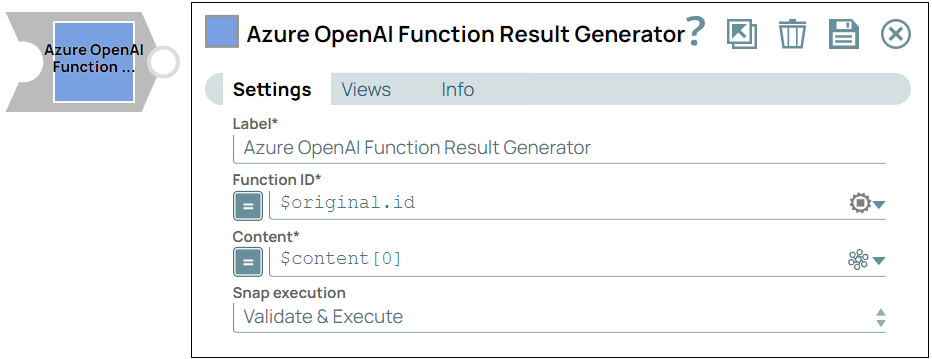
- This is a Transform-type Snap.
 Works in Ultra Tasks
Prerequisites
None.
Limitations and known issues
None.
Snap views
| Type | Description | Examples of upstream and downstream Snaps |
|---|---|---|
| Input | This Snap has one document input view, which represents the output of the tool call invocation. | Mapper |
| Output | This Snap has one document output view, which is an internal representation of a tool call message element based on the tool call invocation content. | Mapper |
| Learn more about Error handling. | ||
Snap settings
- Expression icon (
 ): Allows using
JavaScript syntax to access SnapLogic Expressions to set field values dynamically (if
enabled). If disabled, you can provide a static value. Learn more.
): Allows using
JavaScript syntax to access SnapLogic Expressions to set field values dynamically (if
enabled). If disabled, you can provide a static value. Learn more. - SnapGPT (
 ): Generates SnapLogic Expressions
based on natural language using SnapGPT. Learn
more.
): Generates SnapLogic Expressions
based on natural language using SnapGPT. Learn
more. - Suggestion icon (
 ): Populates a
list of values dynamically based on your Snap configuration. You can select only one
attribute at a time using the icon. Type into the field if it supports a comma-separated
list of values.
): Populates a
list of values dynamically based on your Snap configuration. You can select only one
attribute at a time using the icon. Type into the field if it supports a comma-separated
list of values. - Upload
 : Uploads files. Learn more.
| Field/Field set | Type | Description |
|---|---|---|
| Label*
|
String |
Specify a unique name for the Snap. Modify this to be more appropriate, especially if more than one of the same Snaps is in the pipeline. Default value: Azure OpenAI Function Result Generator (Not Recommended) Example: Generate function results for AI models. |
| Function ID | String/Expression | Required. Specify the function ID that the Azure OpenAI model created for the corresponding tool call invocation. Default value: N/A Example: $id |
| Content | String/Expression | Required. Specify the output content of the tool call invocation that can be sent to the Azure OpenAI model for processing. Default value: N/A Example: $content |
| Metadata | Use this field set to configure the metadata associated with the function result. The metadata is not sent to the model in the tool calling Snaps; instead, it is passed downstream for further use. For example, you could add a log field as metadata to pass the tool execution log downstream. Learn more about how the tool calling Snap parses the message payload. You can click
This improves for agentic-operations coming from sub-agents for Agent Visualizer. |
|
| Key | String/Expression | Specify the key to use for the metadata. If the metadata key is empty, the
Snap displays an error. Default value: N/A Example: key1 |
| Value | String/Expression | Specify the value to use for the metadata. If the metadata value is empty, no
error is displayed, however, appears as null in the output. Default value: N/A Example: value1 |
| Snap execution
|
Dropdown list |
Choose one of the three modes in
which the Snap executes. Available options are:
Default value: Validate & Execute Example: Execute only |
 to display the