


REST OAuth2 SSL Account
Overview
You can use this account type to connect REST Snaps with data sources that use OAuth2 SSL accounts.
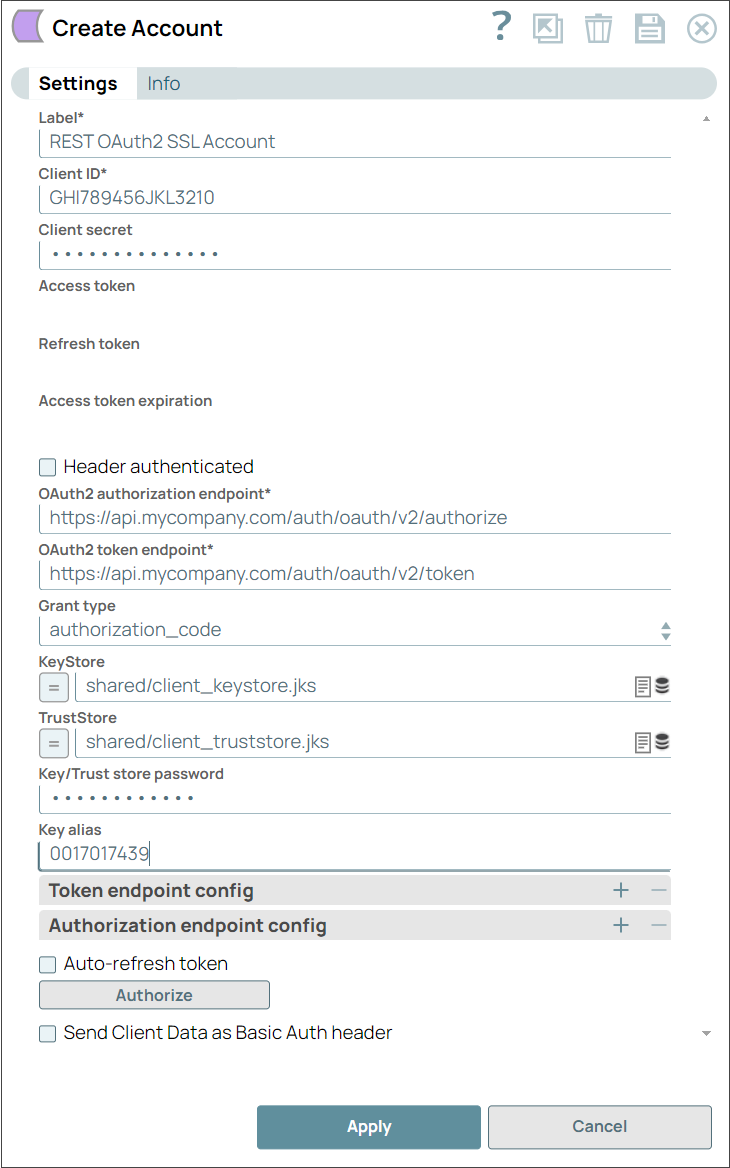
Account settings
- Expression icon (
 ): Allows using
JavaScript syntax to access SnapLogic Expressions to set field values dynamically (if
enabled). If disabled, you can provide a static value. Learn more.
): Allows using
JavaScript syntax to access SnapLogic Expressions to set field values dynamically (if
enabled). If disabled, you can provide a static value. Learn more. - SnapGPT (
 ): Generates SnapLogic Expressions
based on natural language using SnapGPT. Learn
more.
): Generates SnapLogic Expressions
based on natural language using SnapGPT. Learn
more. - Suggestion icon (
 ): Populates a
list of values dynamically based on your Snap configuration. You can select only one
attribute at a time using the icon. Type into the field if it supports a comma-separated
list of values.
): Populates a
list of values dynamically based on your Snap configuration. You can select only one
attribute at a time using the icon. Type into the field if it supports a comma-separated
list of values. - Upload
 : Uploads files. Learn more.
| Field/Field set | Type | Description |
|---|---|---|
| Label | String |
Required.
Required. Enter a unique and meaningful name for your account. Default value: N/A Example: REST OAuth2 Account |
| Client ID | String |
Required. Specify the client ID associated with
your account. You can create the client ID as advised by your
application provider. Default value: N/A Example: 88a731111-07k1-4714-xz5a-de111aaa9a5e |
| Client secret | String |
Required. Enter the client secret associated with
your account. You can create the client secret as advised by your
application provider. An example and its meaning can be found. here. Default value: N/A Example: z111aaa1-aa11-11aa-1a11-0d1111a1111 |
| Access token | String | Auto-generated after authorization. Specify the token that SnapLogic
uses to make API requests on behalf of the user associated with the
client ID. Default value: N/A Example: <Encrypted> |
| Refresh token | String | Auto-generated after authorization. Enter the refresh token
associated with your account. If the refresh token is stored, then the
access token can be refreshed automatically before it expires. Default value: N/A Example: N/A |
| Access token expiration | Integer | Auto-generated after authorization. Specify the access token
expiration value, in seconds.Default: Current Time + 3600
seconds Example: 10000s |
| Header authenticated | Checkbox | Select this checkbox to indicate that the endpoint uses bearer header authentication.Default value: Deselected |
| OAuth2 Endpoint | String | Required. Specify the URL of the endpoint that
authorizes the application. Default value: N/A Example: https://login.microsoftonline.com/common/oauth2/v2.0/authorize |
| OAuth2 Token | String | Required. Enter the URL of the endpoint that
retrieves the token for an authenticated account. Note: If you are using a REST OAuth2 Account, access the account
token through
account.access_token explicitly.
The property must be marked as an expression. An example URL for
LinkedIn is:
Default value: N/A Example: https://api.adp.com/auth/oauth/v2/token |
| Grant Type | Dropdown list | Select one of the following methods for authorization:
Default value: Authorization Code Example: client_credentials |
| KeyStore | String/Expression/ Suggestion | Enter the location of the key store file. It can be in SLDB or at
any other unauthenticated endpoint. Default value: N/A Example: Shared/client_keystore.jks |
| TrustStore | String/Expression/ Suggestion | Enter the location of the trust store file. It can be in SLDB or at
any other unauthenticated endpoint. Default value: N/A Example: Shared/client_truststore.jks |
| Key/Trust store password | String/Expression/ Suggestion | Enter the password for the key/trust store. It is used for both, if
both are defined. Default value: N/A Example: N/A |
| Key alias | String | Enter the alias of the key that you want to use with this account.
Default value: N/A Example: N/A |
| Token endpoint config | Use this field set to
provide custom properties for the OAuth2 token endpoint. Click the + or
- icons to add or remove configuration rows. This field set comprises the following fields:
|
|
| Token endpoint parameter | String | Define an optional token endpoint parameter. Default value: N/A Example: N/A |
| Token endpoint parameter value | String | Enter the value associated with the optional endpoint parameter
defined above. Default value: N/A Example: N/A |
| Auth endpoint config | Use this field set to
provide custom properties for the OAuth2 auth endpoint. Click the + or -
icons to add or remove configuration rows. This field set comprises the following fields:
|
|
| Auth endpoint parameter | String | Define an optional token endpoint parameter. Default value: N/A Example: N/A |
| Auth endpoint value | String | Enter the value associated with the authorization endpoint parameter
defined above. Default value: N/A Example: N/A |
| Auto-refresh token | Checkbox | Select this checkbox to refresh the token automatically using the
refresh token, if the property is enabled. If deselected, the token
expires and is not refreshed automatically. Default status: Deselected |
| Authorize | Button | Click this button to authorize the REST OAuth2 account using the
credentials provided in the Client ID, Client Secret, OAuth2 Endpoint,
and OAuth2 Token fields. Default value: N/A Example: N/A |
| Send Client Data as Basic Auth Header | Checkbox | Select this checkbox to send the client information as a header to
the OAuth endpoint. Default status: Deselected |
Troubleshooting
One or more required field is blank
- Label
- Client ID
- Client secret
- OAuth2 Endpoint
- OAuth2 Token
- Label
- Client ID
- Client secret
- OAuth2 Endpoint
- OAuth2 Token
One or more required field is blank
- Access Token
- Refresh Token
- Access Expiration token
You still click Apply.
- Label
- Client ID
- Client secret
- OAuth2 Endpoint
- OAuth2 Token