


Switch a node to maintenance mode
POST https://{controlplane_path}/api/1/rest/public/snaplex/maintenance/{plex_path}/{hostname} This API requests that the specified JCC node be switched to maintenance mode.
Prerequisites
- Environment (Org) admin permissions
Path parameters
| Key | Description |
|---|---|
controlplane_path |
Required. The SnapLogic control plane host:
elastic.snaplogic.com (US) or
emea.snaplogic.com (EU). |
plex_path |
Required.
The path to the Snaplex.
The path comparison is case-sensitive.
Format:
Example:
|
hostname |
Required.
The JCC node path.
Example:
|
Query parameters
None.
Request header
Basic authentication
To use basic authentication, specify Basic for authorization in the request
header, add your credentials (email and password for your SnapLogic user or service account), and
specify application/json for content type. For example:
Authorization: Basic {base64_encoded <email>:<password>}
Content-Type: application/json
Example of basic authentication using Postman:
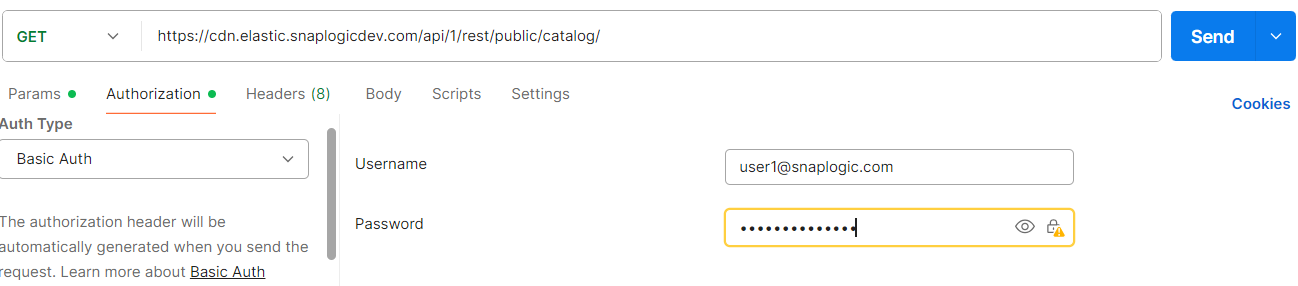
Learn more about the basic authentication header in REST API requests.
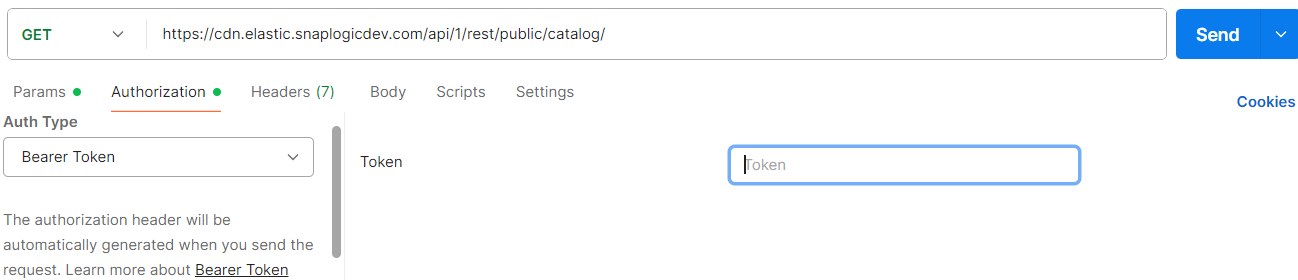
JWT authentication
When using JWT authentication, the API request includes specific headers. In the request header,
specify Bearer Token for authorization, add the token, and specify
application/json for content type. These headers are automatically added when
you configure bearer token authentication in your API client. The authorization header contains
the word Bearer followed by a space and your JWT.
Authorization: Bearer Token {token}
Content-Type: application/json
Example of JWT authentication using Postman:
Request body
{ "mode" : ... }
| Key | Type | Description |
|---|---|---|
mode |
Boolean | If true, the JCC node is set to maintenance mode.
Otherwise, the JCC node is set to running mode.
|
Response
{
    "response_map": {},
    "http_status_code": 200
}