


Interact with SnapGPT
Interact with SnapGPT by entering a prompt or selecting a skill.
You can interact with SnapGPT from the Designer panel and from individual Snaps, including expression-enabled fields, Mapper fields, and SQL statement fields. SnapGPT reads the context of your open pipeline, so you can use natural language to generate pipelines, analyze your work, create descriptions, and more.
Welcome screen
The first time you open SnapGPT in Designer, the welcome screen appears. Click Understood, let's begin to dismiss it and open the home panel.
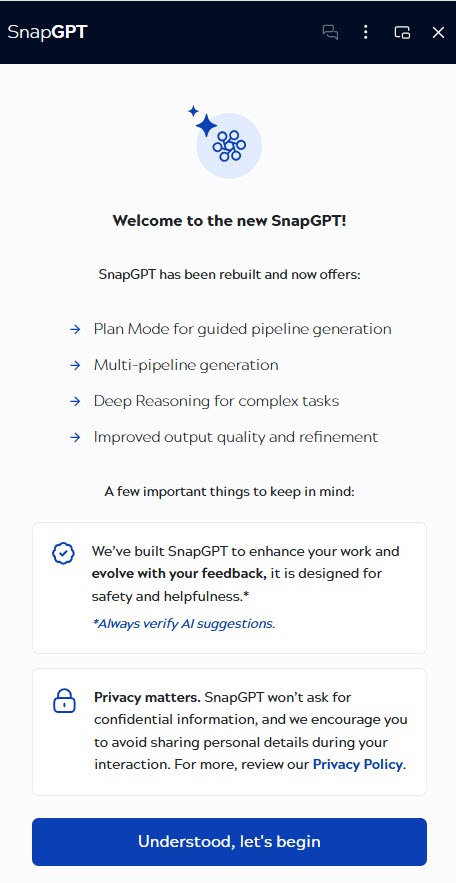
The SnapGPT panel
Open SnapGPT from Designer:

To get started, type a request in the chat prompt or select from the following skills:
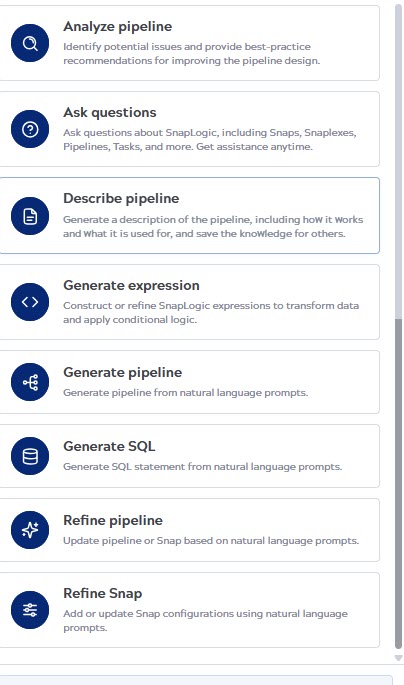
- Analyze pipeline: Identify potential issues and provide best-practice recommendations for improving the pipeline design. Learn more
- Ask questions: Ask questions about SnapLogic, including Snaps, Snaplexes, Pipelines, Tasks, and more. Get assistance anytime.
- Describe pipeline: Generate a description of the pipeline, including how it works and what it is used for. Save the description to the pipeline's Info tab. Learn more
- Generate expressions: Generate expressions in expression-enabled Snap fields and Mapper fields. Learn more
- Generate pipeline: Generate a pipeline from natural language prompts. Learn more
- Generate SQL: Generate a SQL statement from natural language prompts. Learn more
- Refine pipeline: Update a pipeline or Snap based on natural language prompts. Learn more
- Refine Snap: Add or update Snap configurations using natural language prompts. Learn more
SnapGPT prompt panel and related controls

The prompt and related controls display at the bottom of the SnapGPT panel. Use the following controls to interact with SnapGPT:
- Prompt input box: Enter prompts in natural language to trigger any of the SnapGPT skills such as describe or analyze a pipeline.
- Submit Button: Click to send the prompt. The button is disabled if the prompt is empty or if an unsupported file is attached.
- Plus menu (+): Click the plus icon and select any of the options:
- Upload photo: Select or drag an image of a pipeline diagram to add it to the prompt. The image thumbnail appears with the prompt text aligned beside it. Learn more
- Prompt suggestions: Open a dropdown of predefined prompts.
Default options include:
-
Describe pipeline
-
Analyze pipeline
-
Generate pipeline
-
Refine pipeline
-
- Standards: View and apply the pipeline standards for the current session. Standards are applied when generating or refining pipelines. Learn more
-
Think toggle: Enable Think mode for deeper AI reasoning on tasks such as pipeline analysis, Q&A, descriptions, expression generation, and SQL generation. Think mode has higher latency than Standard mode.
Plan toggle: Enable Plan mode for pipeline generation and refinement through a conversational planning loop.
Note: Think and Plan toggles are available before you send the first message. After sending, Think mode locks for the session; to use a different mode, click New chat. Plan mode can be toggled on or off at any point during the session. Learn more about SnapGPT modes.
SnapGPT toolbar

Options available from the SnapGPT toolbar include:
- Chat history icon: Open the Chat history panel to view, search, and manage your previous chats.
- More actions icon (⋮): Open the action menu, which includes Settings, Documentation, and Send us feedback.
- Detach icon: Switch the panel between docked and floating mode. In floating mode, you can drag the panel anywhere on screen and resize it by dragging any edge or corner. Your preference is saved and restored in future sessions.
- Close icon: Close the SnapGPT panel.
Feedback
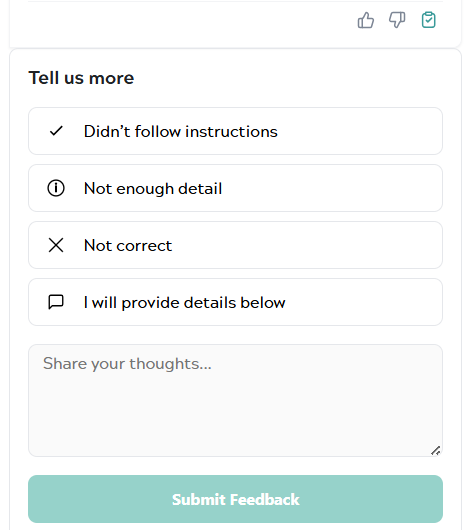
Every SnapGPT response has three icons in the lower right corner. You can click thumbs-up or thumbs-down to rate relevance and accuracy. If you want to share any feedback or suggestions, click the feedback icon. A feedback panel is displayed where you can select a reason or enter your own comments.
Chat history
Click the Chat history icon in the toolbar to open the Chat history panel. Your previous chats are organized into PINNED and RECENT categories, both expanded by default. Click a category name to collapse it.
Click any chat in the list to open it. All the previous chats remain accessible in the Chat history until you delete them. Use the Search chats field to find a specific chat.
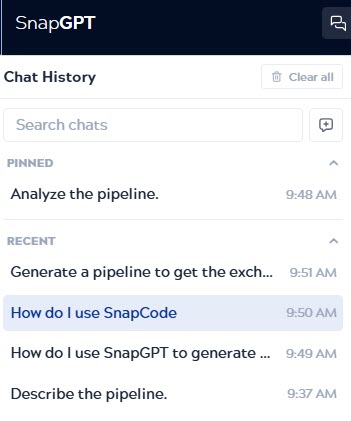
To manage your chats:
- New chat: Click the New chat icon to end the current conversation and start a new one.
- Hover over a chat to view the following options:
- Pin: Click the pin icon to pin the chat. Pinned chats appear under the PINNED category.
- Rename: Click the pencil icon to rename the chat.
- Remove: Click the trash icon to remove the chat.
SnapGPT in Snaps
You can use SnapGPT to generate expressions, mappings, and SQL statements. These skills are context-sensitive:
- Expressions: Available in Snaps with expression-enabled fields.
- Mappings: Available in a Mapper Snap.
- SQL query statements: Available in Snaps with SQL statement text fields.