


SnapLogic Create
Overview
You can use this Snap to create SnapLogic assets, such as accounts, tasks, pipelines, and projects.
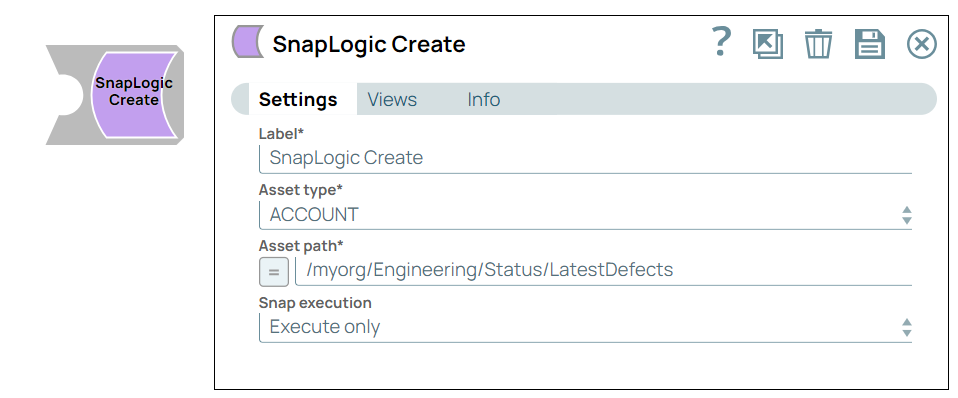
- This is a Write-type Snap.
 Works in Ultra Tasks
Snap views
| Type | Description | Examples of upstream and downstream Snaps |
|---|---|---|
| Input | This Snap has one document input view. Every input document, regardless of asset type, must include these core fields:
|
Mapper |
| Output | This Snap has, at most, one document output view. On successful execution, the Snap outputs a document with the created asset's details:
|
|
| Learn more about Error handling. | ||
Snap settings
Legend:
- Expression icon (
 ): Allows using
JavaScript syntax to access SnapLogic Expressions to set field values dynamically (if
enabled). If disabled, you can provide a static value. Learn more.
): Allows using
JavaScript syntax to access SnapLogic Expressions to set field values dynamically (if
enabled). If disabled, you can provide a static value. Learn more. - SnapGPT (
 ): Generates SnapLogic Expressions
based on natural language using SnapGPT. Learn
more.
): Generates SnapLogic Expressions
based on natural language using SnapGPT. Learn
more. - Suggestion icon (
 ): Populates a
list of values dynamically based on your Snap configuration. You can select only one
attribute at a time using the icon. Type into the field if it supports a comma-separated
list of values.
): Populates a
list of values dynamically based on your Snap configuration. You can select only one
attribute at a time using the icon. Type into the field if it supports a comma-separated
list of values. - Upload
 : Uploads files. Learn more.
| Field/Field set | Type | Description |
|---|---|---|
| Label*
|
String |
Specify a unique name for the Snap. Modify this to be more appropriate, especially if more than one of the same Snaps is in the pipeline. Default value: SnapLogic Create Example: SnapLogic Create1 |
| Asset type | String |
Required. The type of Asset to operate on. Options available include:
Default value: ACCOUNT Example: TASK Note: If the org is configured for Enhanced Account Encryption, the information you use to create an account is automatically encrypted.
|
| Asset path | String/Expression |
Required. Specify the absolute path for the asset in the following format:
Default value: N/A Example: /myorg/Engineering/Status/LatestDefects |
| Snap execution
|
Dropdown list |
Choose one of the three modes in
which the Snap executes. Available options are:
Default value: Execute only Example: Validate & Execute |
Important: The SnapLogic Create Snap is not typically used to create an asset from scratch. Instead, use the SnapLogic Read Snap to retrieve an existing, similar asset and use the returned JSON as a template. Modify the template as needed before passing it to the SnapLogic Create Snap.
This approach reduces the effort required to construct the JSON input manually and helps prevent formatting errors.
Asset-specific input document formats
| Asset Type | Description and Format |
|---|---|
| ACCOUNT | The most documented asset type. The input JSON must include the account's class definition and configuration properties specific to the account type (example, Oracle, Salesforce, JDBC, etc.):
Tip: If Enhanced Account Encryption is enabled on your org, credentials in the input document are automatically encrypted at rest.
|
| TASK | A Task asset input document defines a scheduled or triggered execution of a pipeline:
|
| PIPELINE | A Pipeline asset input document defines the pipeline's JSON structure:
|
| PROJECT | Covers both Projects and Project Spaces:
|
| SNAPLEX | Defines a Snaplex (execution engine) configuration:
|
| FLOWS | SnapLogic Flow assets follow a similar pattern to pipelines but represent low-code/no-code integration flows. |
Troubleshooting
None.