


EDI Formatter
read JSON document data from the input view and convert it into an EDIFACT binary file, that is, formatted according to a specific EDIFACT message type and version.
Overview
You can use this Snap to read JSON document data from the input view and convert it into an EDIFACT binary file, that is, formatted according to a specific EDIFACT message type and version.
- This is a Format-type Snap.
 Does not support Ultra Tasks
Snap views
| Type | Description | Examples of upstream and downstream Snaps |
|---|---|---|
| Input | JSON document containing valid EDIFACT data. | |
| Output | EDIFACT data in binary format. | |
| Learn more about Error handling. | ||
Snap settings
- Expression icon (
 ): Allows using
JavaScript syntax to access SnapLogic Expressions to set field values dynamically (if
enabled). If disabled, you can provide a static value. Learn more.
): Allows using
JavaScript syntax to access SnapLogic Expressions to set field values dynamically (if
enabled). If disabled, you can provide a static value. Learn more. - SnapGPT (
 ): Generates SnapLogic Expressions
based on natural language using SnapGPT. Learn
more.
): Generates SnapLogic Expressions
based on natural language using SnapGPT. Learn
more. - Suggestion icon (
 ): Populates a
list of values dynamically based on your Snap configuration. You can select only one
attribute at a time using the icon. Type into the field if it supports a comma-separated
list of values.
): Populates a
list of values dynamically based on your Snap configuration. You can select only one
attribute at a time using the icon. Type into the field if it supports a comma-separated
list of values. - Upload
 : Uploads files. Learn more.
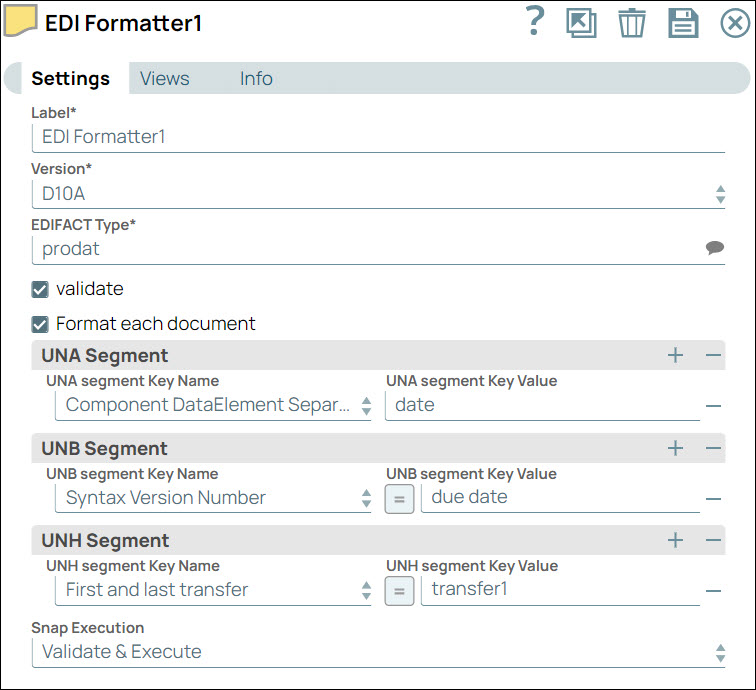
| Field/Field set | Type | Description |
|---|---|---|
| Label*
|
String |
Specify a unique name for the Snap. Modify this to be more appropriate, especially if more than one of the same Snaps is in the pipeline. Default value: EDI Formatter |
| Version | Dropdown list/Expression | Required. The EDIFACT version of the input data.
Available options are:
Default value:
Example:
|
| EDIFACT Type | String/Expression/ Suggestion | Required. The EDIFACT message type. The Snap suggests
available types based on the selected version.
For available message types by version, see EDIFACT message type. Default value: N/A Example:
|
| Validate | Checkbox | Validates the input data against the selected EDIFACT version and type to
ensure the input is well-formed and respects the required EDIFACT type structure. Default status: Deselected |
| Format each document | Checkbox | If selected, each incoming document is formatted into a separate EDIFACT binary
output, each with its own UNA/UNB header. If deselected, all incoming documents are aggregated into a single binary output with one UNA/UNB header and UNZ trailer. Default status: Deselected |
| Ignore empty tabs | Checkbox | Select this checkbox to ignore any empty or null JSON fields from the EDIFACT
output. Default status: Selected |
| UNA | The UNA field set is used to define the service string advice, which specifies the separators and indicators used in the interchange. | |
| UNA Name | Dropdown list | The name of the UNA segment element to add. Available options are:
Default value: N/A Example: |
| UNA Value | String/Expression | The value of the UNA segment. Default value: N/A Example: 234 |
| UNB | The UNB field set is used to define the interchange header, which contains routing and identification information for the EDI interchange. | |
| UNB Name | Dropdown list | Specify the key name of the UNB segment. Available options are:
Default value: Syntax version number Example: Acknowledgement request |
| UNB Value | String/Expression | The value of the UNB segment. Default value: N/A Example: |
| UNH Segment | The UNH field set is used to define the message header, which contains key metadata information for identifying and processing the EDI message. | |
| UNH Name | Dropdown list | Specify the key name of the UNH segment. Available options are:
Default value: Message reference number Example: First and last transfer |
| UNH Value | String/Expression | The value of the UNH segment. Default value: N/A Example: |
| Snap execution
|
Dropdown list |
Choose one of the three modes in
which the Snap executes. Available options are:
Default value: Validate & Execute Example: Execute only |
EDIFACT message type
Available EDIFACT message types for each version are:
| Version | Type |
|---|---|
| D00A |
|
| D00B |
|
| D10A |
|
| D10B |
|
| D11B |
|
| D18A |
|
| D95B |
|
| D96B |
|
| D98B |
|
| D99B |
|