


Generic JDBC Execute
Overview
You can use this Snap to execute a SQL statement/query against a SQL database. This Snap also supports DCL commands (Grant and Revoke).
-
This Snap works only with single queries.
-
This Snap only supports conversion of standard JDBC specification 4.1 types listed here. Learn more about the JDBC 4.1 specification. If you want database-specific conversion, then a database specific Snap pack should be used. For example, for handling TIMESTAMPTZ and TIMESTAMPLTZ formats, you should use the Oracle Snap Pack.
-
The Generic JDBC - Execute Snap is used for simple DDL (SELECT, INSERT, UPDATE, DELETE) type statements. This Snap also supports DML operations (CREATE, ALTER, INSERT, and SELECT) when using AWS Athena database.
- This is a Write-type Snap.
 Works in Ultra Tasks
Known issues
- If a SELECT query in the SQL statement field in the Snap Settings contains duplicate
column names, then the query result displays the column name twice, with the latter
prefixed with the table name. If the column name occurs more than twice, the second
entry is still prefixed with the table name, but it displays the value of the column
mentioned last in the query. The example below illustrates this behavior.
Incorrect results for SELECT queries with duplicate column names
Example
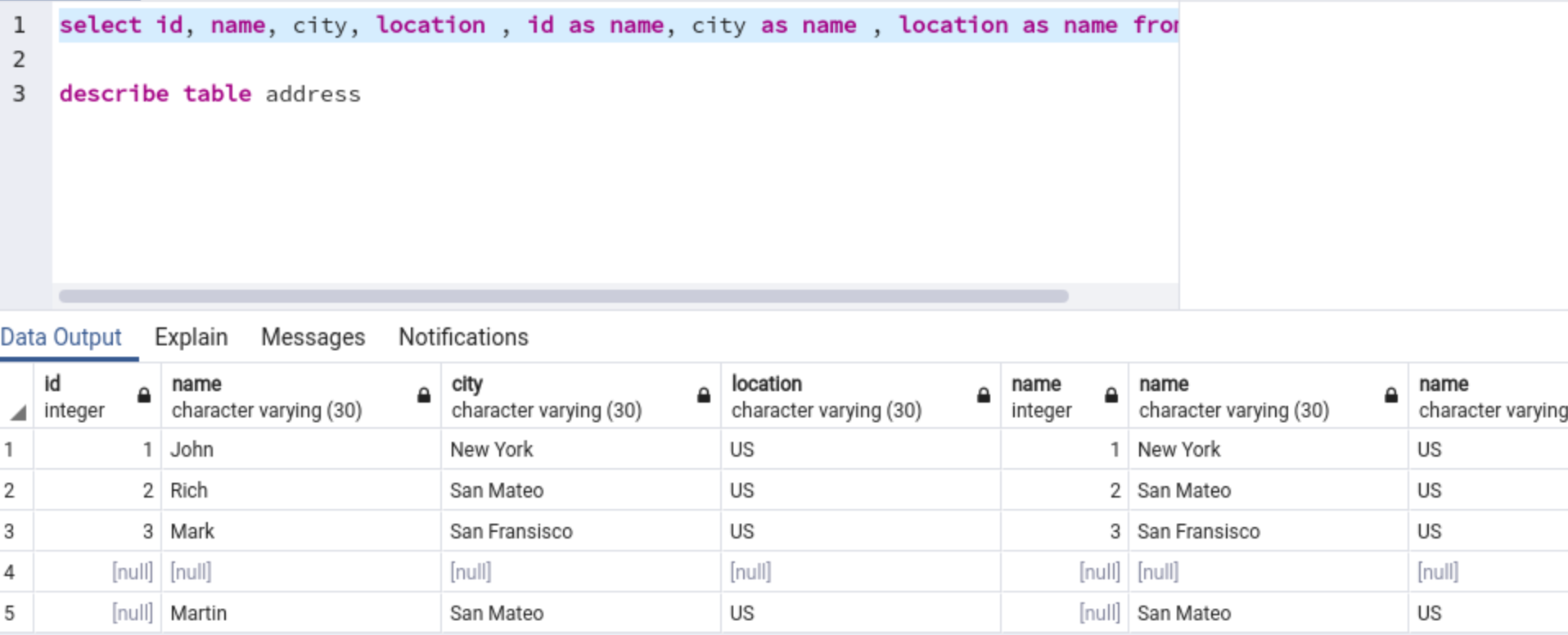
Consider the following query, where the column name "
name" is repeated three times:select id, name, city, location, id as name, city as name, location as name from addressExpected output:
The Generic JDBC - Execute Snap's output should reflect the correct query result containing all the six fields, as shown in the image below:
Actual Output:
The Snap's output displays the repeat occurrence of the column "
name"only once, prefixed with the table name "address" as shown in the image below. Further, it holds the value of the table column "location", which was mentioned last in theSELECTquery.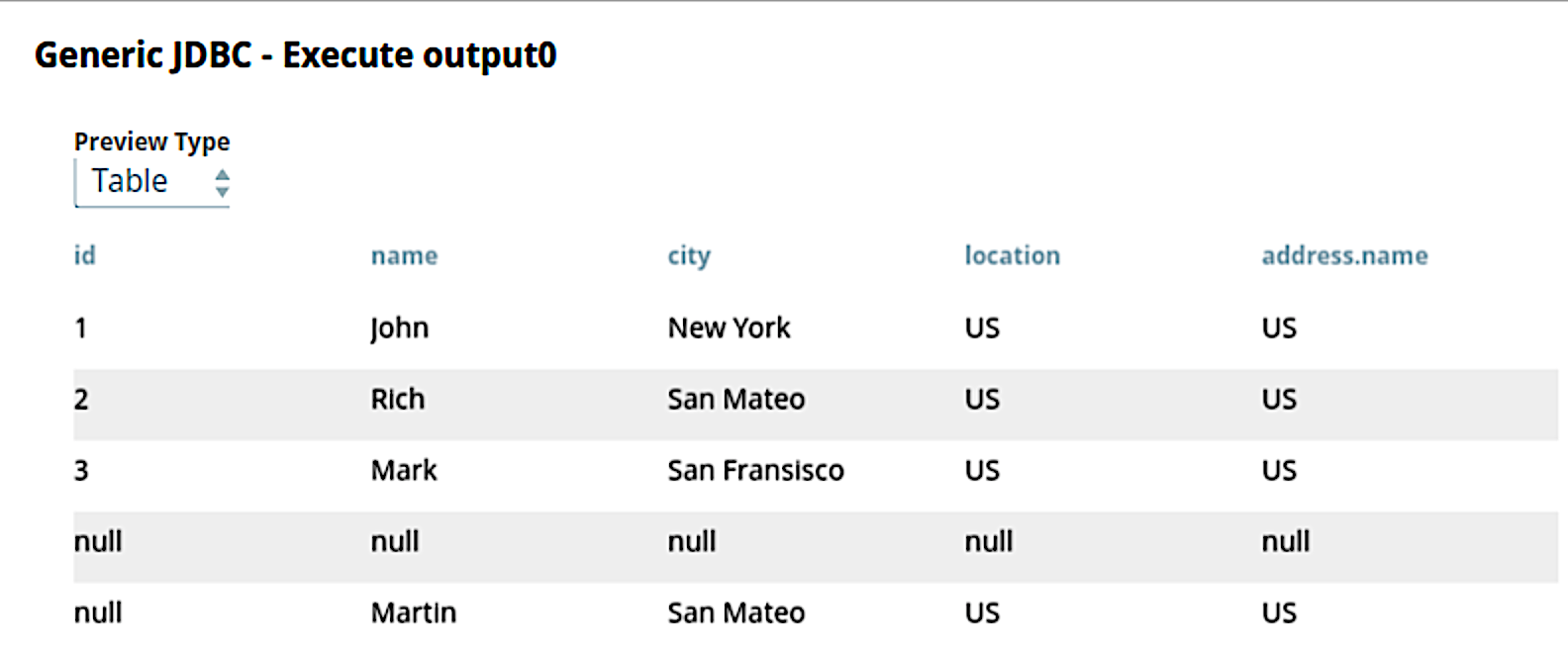
To avoid this issue, we recommend that you give unique column names in the query.
-
The metadata output in the second output preview is not displayed in table format when your target database is AWS Athena.
-
The suggestions list is not populated for Table name field when your target database is AWS Athena.
-
When the SQL statement property is an expression, the Pipeline parameters are shown in the suggest, but not the input schema.
-
When the Generic JDBC - Execute Snap connects to the Sybase database to retrieve
BigTime-type data, the Snap displays both date and time for the data type.
Behavior changes
Improved the output for the CLOB data type when used with the SELECT statement in the Generic JDBC - Execute Snap. This update has resulted in the following Behavior change:
- Previously, the output for a Teradata object displayed as shown
below:
"col_clob": "com.teradata.jdbc.jdk6.JDK6_SQL_Clob@2f8e6bdd" - With
442patches32366, the output now reflects the actual content inserted, as shown below:"col_clob": "This is a CLOB text"
Snap views
| Type | Description | Examples of upstream and downstream Snaps |
|---|---|---|
| Input | The input data typically includes the SQL query that you want to execute on your database. The specific format of the input data can vary depending on the design of your pipeline and the data source you are using, but typically it can be the SQL query. In addition to the SQL query, you may also need to provide additional parameters that need to be substituted in the query. | |
| Output | If an output view is available and an update/insert/merge/delete statement was executed, then the original document that was used to create the statement will be output with the status of the executed statement. | |
| Learn more about Error handling. | ||
Snap settings
- Expression icon (
 ): Allows using
pipeline parameters to set field values dynamically (if enabled). SnapLogic Expressions
are not supported. If disabled, you can provide a static value.
): Allows using
pipeline parameters to set field values dynamically (if enabled). SnapLogic Expressions
are not supported. If disabled, you can provide a static value. - SnapGPT (
 ): Generates SnapLogic Expressions
based on natural language using SnapGPT. Learn
more.
): Generates SnapLogic Expressions
based on natural language using SnapGPT. Learn
more. - Suggestion icon (
 ): Populates a
list of values dynamically based on your Snap configuration. You can select only one
attribute at a time using the icon. Type into the field if it supports a comma-separated
list of values.
): Populates a
list of values dynamically based on your Snap configuration. You can select only one
attribute at a time using the icon. Type into the field if it supports a comma-separated
list of values. - Upload
 : Uploads files. Learn more.
| Field/Field set | Type | Description | |||||||||
|---|---|---|---|---|---|---|---|---|---|---|---|
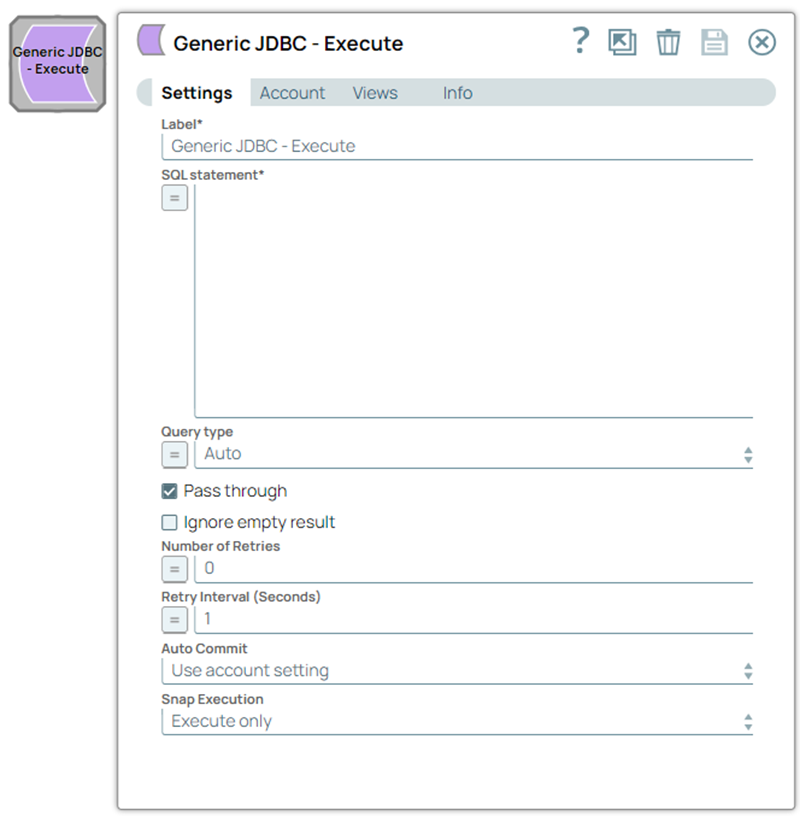
| Label*
|
String | Specify a unique name for the Snap. Modify this to be more appropriate, especially if more than one of the same Snaps is in the pipeline. Default value: Generic JDBC - Execute Example: Execute EmployeeRecords |
|||||||||
| SQL statement | String/Expression | Required. Specify the SQL statement to execute on the server. Note: We recommend you to add a single query in the SQL Statement
field. There are two possible scenarios that you encounter when working with SQL statements in SnapLogic. Tip: Scenarios to
successfully execute your SQL statements
Scenario 1: Executing SQL statements without expressions.If the
expression toggle of the SQL statement field is not selected:
Additionally, the JSON path is allowed only in the WHERE clause. If the SQL statement starts with SELECT (case-insensitive), the Snap regards it as a select-type query and executes once per input document. If not, it regards it as write-type query and executes in batch mode. Scenario 2:
Executing SQL queries with expressions. If the expression toggle of the
SQL statement field is selected:
Note: Table name and column names must not be provided as bind
parameters. Only values can be provided as bind parameters. We recommend you use
the Oracle - Stored Procedure Snap for
invoking procedures when using Oracle database with this Snap due to the
following limitation while invoking procedures:
Note:
Warning:
Single quotes in values must be escaped. Any relational database (RDBMS)
treats single quotes ( For example:
Values can be substituted into the query/statement by using a JSON path using a $ to start the path. For example, for the given document
data: During design time if you specify query such as, then the run-time
query is: Note: To invoke procedures when using Oracle database with this
Snap, we recommend you use the Oracle Stored Procedure Snap. Default value: N/A Example: INSERT into SnapLogic.book (id, book) VALUES ($id,$book) |
|||||||||
| Query Type | Dropdown list/Expression | Select the type of query for your SQL statement (Read or Write). When Auto is selected, the Snap tries to determine the query type automatically. If the execution result of the query is not as expected, you can change the query type to Read or Write. Default value: Auto Example: Read |
|||||||||
| Pass through | Checkbox |
Select this checkbox to pass the input data to the output view under the key
' Default status: Deselected |
|||||||||
| Ignore empty result | Checkbox |
Select this checkbox to ignore empty result; no document is written to the output view when a SELECT operation does not produce any result. If you deselect this checkbox and select the Pass through option, the input document is passed through to the output view.Default value: Default status: Deselected |
|||||||||
| Number of retries | Integer/Expression | Specify the maximum number of attempts to be made to receive a response. The
request is terminated if the attempts do not result in a response. Note:
If you provide a string value, the Snap displays the following error:
You can use a string value only when the field is expression-enabled. Default value: 0 Example: 3 |
|||||||||
| Retry interval (seconds) | Integer/Expression | Specifies the time interval between two successive retry requests. A retry
happens only when the previous attempt resulted in an exception. Default value: 1 Example: 10 |
|||||||||
| Auto commit | Dropdown list | Select one of the options for this property to override the state of the
Auto commit property on the account. The Auto commit at the
Snap-level has three values: True, False, and Use account
setting. The expected functionality for these modes are:
Note:
Warning: Behavior of DML Queries in Database Execute Snap when
auto-commit is false
DDL queries used in the Database Execute Snap will be committed by the Database itself, regardless of the Auto-commit setting.When Auto commit is set to false for the DML queries, the commit is called at the end of the Snap's execution. The Auto commit needs to be true in a scenario where the downstream Snap does depend on the data processed on an Upstream Database Execute Snap containing a DML query. When the Auto commit is set to the Use account setting on the Snap, the account level commit needs to be enabled. Default value: Use account setting Example: True |
|||||||||
| Snap execution
|
Dropdown list |
Choose one of the three modes in
which the Snap executes. Available options are:
Default value: Execute only Example: Validate & Execute |