


Redshift SSL Account
Overview
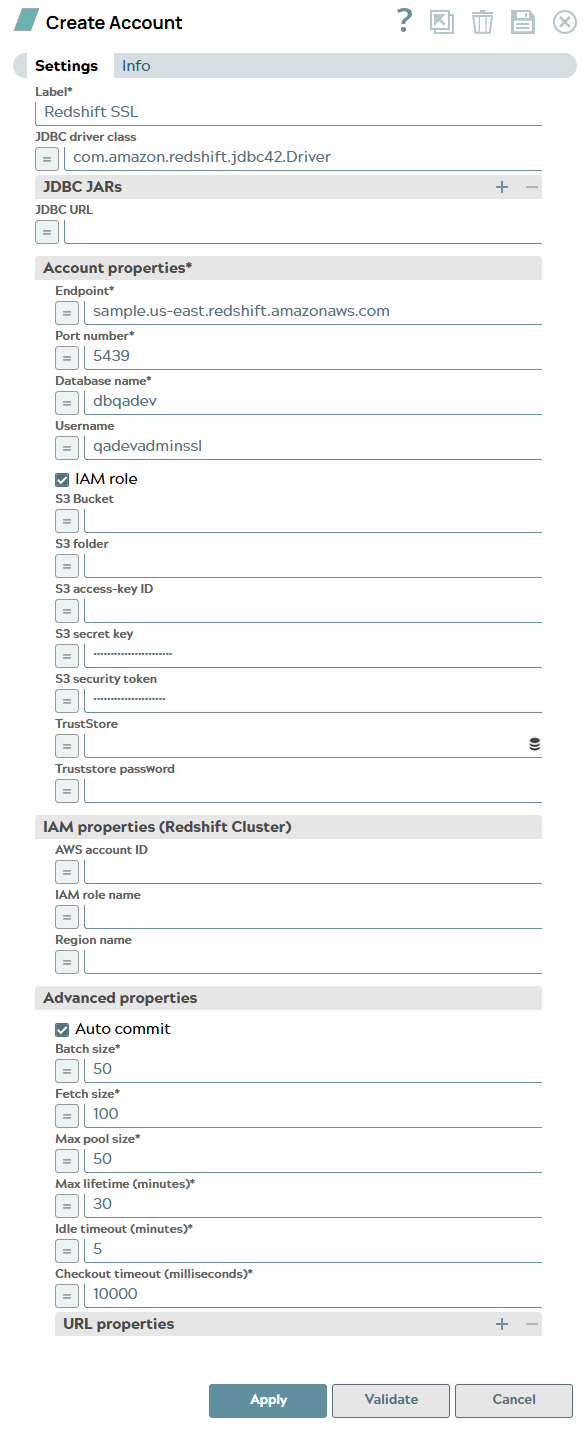
Account Settings
| Field/Field set | Description | ||
|---|---|---|---|
|
Label
|
Required. Specify a unique label for the account.
Example: Redshift SSL Account |
||
|
JDBC driver class
|
The name of the JDBC driver class to use. By default, the com.amazon.redshift.jdbc42.Driver class is bundled with the Snap Pack.
Default value:
Example: org.postgresql.Driver |
||
|
JDBC JARs
|
Use this field set to add a list of JDBC JAR files to be loaded. By default, the Redshift account is bundled with the JDBC v2.1.0.29 driver. However, you can add a custom JAR file. Click + to add a new row for each JDBC JAR file. | ||
|
JDBC driver
|
The Redshift Snap Pack is bundled with the default Redshift JDBC driver v2.1.0.29. Therefore, even if you do not provide a JDBC Driver, the account does not fail. | ||
|
JDBC URL
|
Enter the URL of the JDBC database.
Example: jdbc:redshift://hostname:port/database |
||
| Account properties | |||
|
Endpoint
|
Required. Enter the server's address.
Example: examplefield.us-test-1.redshift.yourendpoint.com |
||
|
Port number
|
Required. Enter the database server's port.
Default value:
Example: 5439 |
||
|
Database name
|
Required. Enter the name of the database.
Example: snaplogic |
||
|
Username
|
Enter the username to connect to the database. The username will be used as the default username when retrieving connections. The username must be valid in order to set up the data source.
Example: redshiftadmin |
||
|
IAM role
|
Required. Select this checkbox to automatically generate temporary credentials if your Groundplex is configured with IAM role to access the Redshift instance. The Password field is not needed if you select this checkbox.
Default status: Deselected |
||
|
Password
String |
Enter the password to connect to the data source. The password will be used as the default password when retrieving connections. The password must be valid in order to set up the data source. You must provide a valid password to set up the data source unless you select the IAM role checkbox.
Example: p@$$20d* |
||
|
S3 bucket
|
Required. Enter the external S3 Bucket name residing in an external AWS account to use for staging data in Redshift.
Note: This field is required when using Redshift Bulk Load, Redshift Bulk Upsert, Redshift S3 Upsert, and Redshift Unload Snaps.
Example: sl-bucket-ca |
||
|
S3 folder
|
Enter the relative path to a folder in S3 Bucket. This is used as a root folder for staging data in Redshift.
Example: s3://bucket-name/folder-name |
||
|
S3 access-key ID
|
Required. Enter the S3 Access key ID part of the AWS authentication.
Note: This field is required when using Redshift Bulk Load, Redshift Bulk Upsert, Redshift S3 Upsert, and Redshift Unload Snaps if the IAM role checkbox is not selected.
Example: NAVRGGRV7EDCFVLKJH |
||
|
S3 secret key
String |
Required. Enter the S3 Secret key part of AWS Authentication.
Note: This field is required when using Redshift Bulk Load, Redshift Bulk Upsert, Redshift S3 Upsert, and Redshift Unload Snaps if the IAM role checkbox is not selected.
Example: 2RGiLmL/6bCujkKLaRuUJHY9uSDEjNYr+ozHRtg |
||
|
S3 security token
|
Required. Specify the S3 security token part of the AWS Security Token Service (STS) authentication. It is not required unless a specific S3 credential is configured to require it. Note that only global STS regions are supported.
Note: This field is required when using Redshift Bulk Load, Redshift Bulk Upsert, Redshift S3 Upsert, and Redshift Unload Snaps if the IAM role checkbox is not selected.
Example: FwoGYXdzEGUaDFInugbfGX8xlGA4ZwNWCiV3uSQBjIre4G7AXvfuGO2Fq41wDp7cLCuGAZvKGc4TcSknLVYpI2amWKf9z21+7oszQ== |
||
|
TrustStore
|
Enter the location of the trust store file. It can be located in SLDB or any other unauthenticated endpoint. You can also browse for the location.
Example: redshiftstore4 |
||
|
Truststore password
String |
Enter the password for the truststore file. | ||
| IAM properties (Redshift Cluster) | |||
|
AWS account ID
|
Required. Enter the ID of the Amazon Web Services account to be used for performing the bulk load operation.
Note: This field is required when using Redshift Bulk Load, Redshift Bulk Upsert, Redshift S3 Upsert, and Redshift Unload Snaps if the IAM role checkbox is selected.
Example: AWS-1 |
||
|
IAM role name
|
Required. Enter the name of the IAM role that has been assigned to the Redshift cluster to access the S3 bucket provided above.
Note: This field is required when using Redshift Bulk Load, Redshift Bulk Upsert, Redshift S3 Upsert, and Redshift Unload Snaps if the IAM role checkbox is selected.
Example: rolex |
||
|
Region name
|
Enter the name of the region of the Redshift cluster.
Example: us-east-1 |
||
| Advanced properties | |||
|
Auto commit
|
Select this checkbox to enable the Snap to commit offsets automatically as messages are consumed and sent to the output view.
Default status: Selected |
||
|
Batch size
|
Required. Enter the number of statements to execute at a time. Select queries are not batched.
Note: User-defined types are not supported if a JDBC driver with a version other than 11.2.0.4.0 is set.
Default value:
Example: 50 |
||
|
Fetch size
|
Required. Enter the number of rows to fetch at a time when executing a query.
Note: User-defined types are not supported if a JDBC driver with a version other than 11.2.0.4.0 is set.
Default value:
Example: 100 |
||
|
Max pool size
|
Required. Enter the maximum number of connections a pool will maintain at a time.
Note: Redshift Bulk Load/Bulk Upsert/S3 Upsert Snap requires a minimum of 2 connections per Snap in a pipeline. For example, if a pipeline has a Redshift Bulk Load Snap and an S3 Upsert Snap, then the pool size must be greater than or equal to 4 for successful execution.
Default value:
Example: 30 |
||
|
Max lifetime (minutes)
|
Required. Enter the maximum lifetime of a connection in the pool. Ensure that the value you enter is a few seconds shorter than any database or infrastructure-imposed connection time limit. A value of 0 indicates an infinite lifetime, subject to the Idle Timeout value. An in-use connection is never retired. Connections are removed only after they are closed.
Default value:
Example: 10 |
||
|
Idle timeout (minutes)
|
Required. Enter the maximum amount of time a connection is allowed to sit idle in the pool. A value of 0 indicates that idle connections are never removed from the pool.
Default value:
Example: 6 |
||
|
Checkout timeout (milliseconds)
|
Required. Enter the number of milliseconds to wait for a connection to be available when the pool is exhausted.
Note: If you enter 0 for this value, the Snap waits infinitely until the connection is available. Therefore, we recommend you not enter 0 for Checkout Timeout.
Default value:
Example: 800 |
||
| URL properties | |||
|
URL property name
|
Enter the URL property name. | ||
|
URL property value
|
Enter the URL property value. | ||