


Azure SQL Dynamic Account
Overview
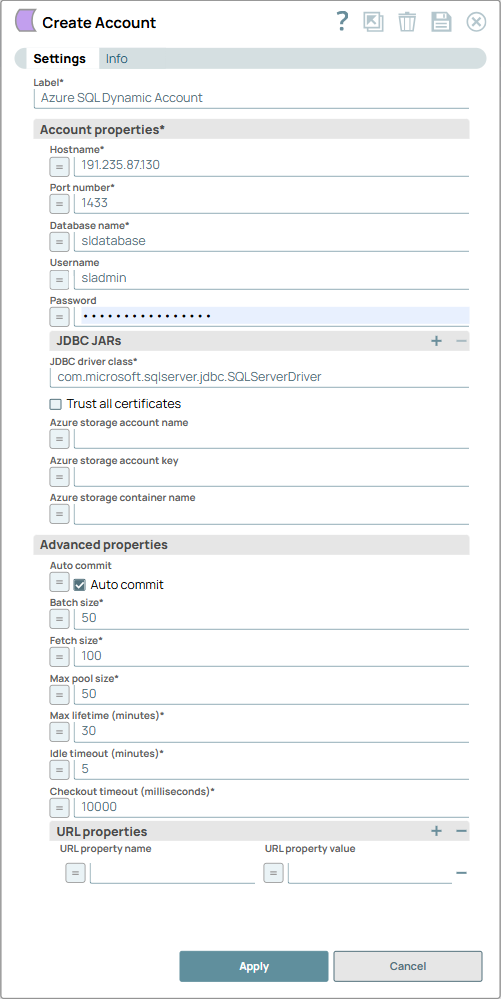
You can use this account type to connect Azure SQL Snaps with data sources that use Azure SQL Dynamic account.
Dynamic Account types support Secrets Management, a SnapLogic add-on that allows you to store endpoint credentials in a third-party secrets manager. Orgs using Secrets Management provide the information necessary to retrieve the secrets in expression-enabled dynamic Account fields. During validation and execution, Pipelines obtain the credentials directly from the secrets manager. Learn more about Secrets Management.
Prerequisites
- Valid Database and JDBC driver.
- Valid Azure Storage credentials.
Limitations and known issues
None.
Account settings
| Field/Field set | Description |
|---|---|
Label*
String |
Required. Unique name for the account. Default value: N/A |
| Account properties | Enter in the information to create a connection to the database. This field set contains the following fields: |
Hostname
String/Expression |
Required. Specify the server's address to connect to.
Default value: N/A Example: |
Port number
String/Expression |
Required. Specify the database server's port to connect to.
Default value: Example: |
Database name
String/Expression |
Required. Specify the database name to connect to.
Default value: N/A Example: |
Username
String/Expression |
Specify the username that is allowed to connect to the database. Username will be used as the default username when retrieving connections. The username must be valid in order to set up the data source.
Default value: N/A Example: |
Password
String/Expression |
Specify the password used to connect to the data source. Password will be used as the default password when retrieving connections. The password must be valid in order to set up the data source.
Default value: N/A Example: |
JDBC JARs
Fieldset |
Use this fieldset to define the JDBC JAR files to be loaded. This field set contains the following fields: |
JDBC driver class
String |
Required. Specify the JDBC driver class name to use.
Default value: Example: |
Trust all certificates
Checkbox |
Select if all SSL certificates are to be accepted for connecting to the database.
Default value: Deselected |
Azure storage account name
String/Expression |
Name with which Azure Storage was created. The Bulk Load Snap automatically appends the .blob.core.windows.net domain to the value of this property.
Default value: N/A Example: |
Azure storage account key
String/Expression |
Specify the key generated by Azure for this account.
Default value: N/A Example: |
Azure storage container name
String/Expression |
Specify the name of the existing Azure storage container.
Default value: N/A Example: |
| Advanced properties | Specify advanced properties for connecting to the database. This field set contains the following fields: |
Auto commit
Checkbox/Expression |
Select this checkbox to commit each of the batches immediately after it is executed. If the Snap fails, only the batch being executed at that moment is rolled back.
Deselect this checkbox to commit the output only after all the batches are executed. If the Snap fails, the entire transaction is rolled back, unless the Snap finds invalid input data before it sends the insert request to the server, and routes the error documents to the Error view. Default value: Selected |
Batch size
Integer/Expression |
Required. Specify the number of statements to execute at a time.
Note:
Default value: Example: |
Fetch size
Integer/Expression |
Required. Specify the number of rows to fetch at a time when executing a query.
Large values could cause the server to run out of memory. Default value: Example: |
Max pool size
Integer/Expression |
Required. Specify the maximum number of connections a pool will maintain at a time.
Default value: Example: |
Max lifetime (minutes)
Integer/Expression |
Required. Specify the maximum lifetime (in minutes) of a connection in the pool. Ensure that the value you enter is a few seconds shorter than any database or infrastructure-imposed connection time limit. A value of 0 indicates an infinite lifetime, subject to the Idle Timeout value. An in-use connection is never retired. Connections are removed only after they are closed.
Default value: |
Idle timeout (minutes)
Integer/Expression |
Required. Specify the maximum amount of time (in minutes) a connection is allowed to sit idle in the pool. A value of 0 indicates that idle connections are never removed from the pool.
Default value: |
Checkout timeout (milliseconds)
Integer/Expression |
Required. Specify the timeout (in milliseconds) to wait
for a connection to be available when the pool is exhausted. Zero waits forever. An
exception will be thrown after the wait time has expired. Note:
If you specify Default value:
|
URL properties
Fieldset |
Use this fieldset to set additional URL properties if any. This field set contains the following fields: |
URL property name
String/Expression |
Specify the URL property name.
Default value: N/A |
URL property value
String/Expression |
Specify the URL property value.
Default value: N/A |