


BigQuery - Table Create
Use this Snap to create Google BigQuery tables that support clustering and partitioning.
Overview
You can use this Snap to create Google BigQuery tables that support clustering and partitioning.
- Snap Type: Write
 Works in Ultra Tasks
Prerequisites
A valid Google BigQuery account with the required permissions.
Limitations and Known Issues
- The
rounding_modeoption for BIGNUMERIC and NUMERIC data type fields is not supported. These data type fields fields can be configured on the Google Cloud console. - This Snap considers only the following JSON keys in the schema during table creation (any other keys given are ignored):
nametypemodedescriptionfields
In the following example, the Snap creates the table with the with name, type, and mode keys but ignores defaultValueExpression. There is no error displayed for unsupported keys.
[{
"name": "sales",
"type": "FLOAT",
"mode": "NULLABLE",
"defaultValueExpression": "2.55"
}]
Supported Accounts
This Snap works with the following account types. For more information, see Configuring Google BigQuery Accounts.
Snap Views
| Type | Format | Number of Views | Examples of Upstream and Downstream Snaps | Description |
|---|---|---|---|---|
| Input | Document |
|
|
The Project ID and the Document ID. |
| Output | Document |
|
|
The list of Table IDs along with their Project IDs, Dataset IDs, and Table type. |
| Learn more about Error handling. | ||||
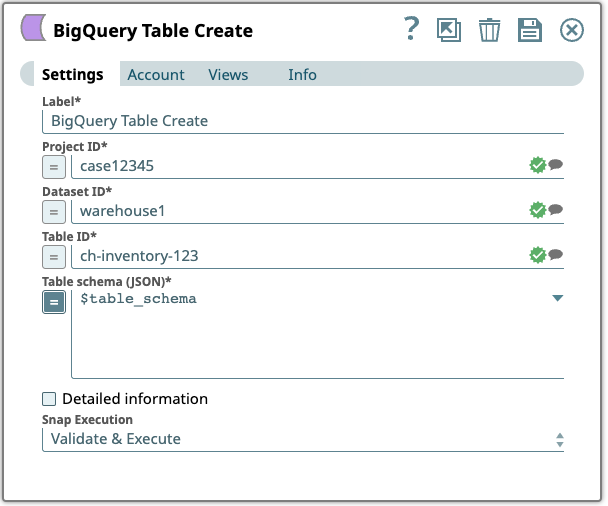
Snap Settings
| Field/Field set | Description | ||
|---|---|---|---|
| Label String |
Specify a unique name for the Snap. Modify this to be more specific, especially if you have more than one Snap of the same type in your pipeline. Default value: BigQuery Table Create Example: Collegenames Table Create |
||
| Project ID String/Expression |
Specify the project ID in which the dataset resides. Default value: N/A Example: test-project-12345 |
||
| Dataset ID String/Expression |
Specify the dataset ID of the destination. Default value: N/A Example: dataset-12345 |
||
| Table ID String/Expression |
Specify the table ID of the table you are creating. This is a unique ID that you must provide (it is not automatically created or assigned). Learn more about creating valid BigQuery table names. Default value: N/A Example: table-12345 |
||
| Table Schema (JSON) String |
Enter the JSON schema for the table. |
||
| Detailed Information Checkbox |
Select this checkbox to enable the Snap to access additional fields for displaying them in the output. Default value: Deselected |
||
| Default table expiration (in days) String/Expression |
New tables created in this dataset will be automatically deleted in the number of days specified. Appears when you select the Detailed Information checkbox. |
||
| Partitioning |
Use this field set to define partitioning requirements. |
||
| Enable partitioning Checkbox |
Select to configure partitioning. Default value: Deselected Appears when you select the Partitioning dropdown. |
||
| Require partitioning filter Checkbox |
Select to require users to include a WHERE clause that specifies the partitions to query each time they query the table. Select the partitioning type (time or range) and the partitioning time (time interval after which a new partition is created). Default value: Deselected Appears when you select the Enable Partitioning checkbox. |
||
| Clustering |
Use this field set to define clustering requirements. |
||
| Enable clustering Checkbox |
Select to configure clustering. Default value: Deselected Appears when you select the Clustering dropdown. |
||
Snap execution
Dropdown list |
Choose one of the three modes in
which the Snap executes. Available options are:
Default value: Validate & Execute Example: Disabled |
||
Implicit retries in BigQuery Snaps
The BigQuery Snaps handle all retriable BigQuery errors (BigQuery exception, IO exception, and Runtime exception) internally.
- 429 (Too Many Requests):
- Retry attempts: Maximum of 5 retries.
- Delay Between Retries: Backoff strategy with jitter (random variation) is applied to prevent synchronized retries and reduce load.
- 401 (Unauthorized):
- Retry attempts: Maximum of 3 retries.
- Delay Between Retries: Backoff strategy is applied.
- Additional Actions: Reloads the BigQuery account on the retry event.
- IOException and 500, 502, 503, 504 (Server Errors):
- Retry attempts: Maximum of 3 retries.
- Delay Between Retries: Backoff strategy is applied.