


Azure SQL Entra Account
Overview
You can use the Azure SQL Entra account type to connect Azure SQL Snaps with data sources that use Azure SQL Entra account.
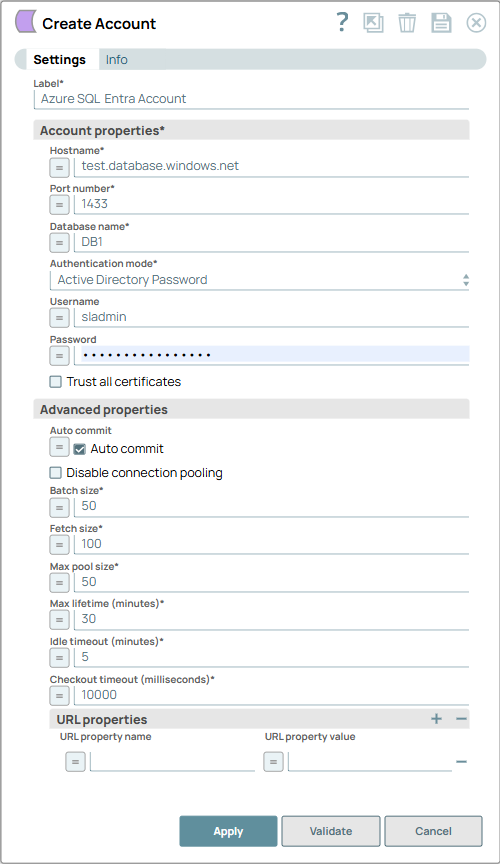
Prerequisites
- Valid Database to connect.
- Valid JDBC JAR file.
Limitations
- When you select the Disable Connection Pooling checkbox, the account forces the session state to close the existing connection and reopen another connection to the database for each Snap until the Pipeline is executed, which might affect the performance. Therefore, we recommend that you select the Disable Connection Pooling checkbox only when there is clear isolation between Snap executions within a Pipeline.
Known issues
Supports only reading JSON files.
Account settings
| Field/Field set | Description |
|---|---|
Label*
String |
Required. Unique name for the account. Default value: N/A |
Account properties
Fieldset |
Required. Enter the information to create a connection to the database. |
Hostname
String/Expression |
Required. Specify the server's address to which you must
connect. Default value: N/A Example: test.database.windows.net |
Port number
Integer/Expression |
Required. Specify the port number of the database server
to which you must connect. Default value: 1433 Example: 1433 |
Database name
String/Expression |
Required. Specify the name of the database to which you
must connect. Default value: N/A Example: DB1 |
Authentication mode
Dropdown list |
Required. Select one of the following options for Azure
SQL Authentication:
Note:
Default value: Active Directory Password Example: Active Directory Service Principal |
Client ID
String/Expression |
Appears when you select Active Directory Service Principal Certificate as the Authentication mode. Required. Specify the ID of an Azure Active Directory application.Default value: N/A Example: d4cbb84cbd-cv87-bc75-78yv-90fcd-b319c51 |
Keystore
String/Expression |
Appears when you select Active Directory Service Principal Certificate as the Authentication mode. Required. Specify the location of the keystore file. The location can be SLDB or any other unauthorized endpoint.Default value: N/A Example: CertificateWithoutPwd.pfx |
Keystore password
String/Expression |
Appears when you select Active Directory Service Principal Certificate as the Authentication mode. Specify the password for the keystore file. Default value: N/A Example: 1234test |
Key alias
String/Expression |
Appears when you select Active Directory Service Principal Certificate as the Authentication mode. Required. Specify the alias of the private key used from the keystore file.Default value: N/A Example: thisisanalias |
Private key passphrase
String/Expression |
Appears when you select Active Directory Service Principal Certificate as the Authentication mode. Specify the passphrase for the private key. You can leave the field empty if the passphrase is the same as the keystore password. Default value: N/A Example: 1234test |
Username
String/Expression |
Appears when you select Active Directory Password as the Authentication mode. Specify the username that is allowed to connect to the database. This username is used as the default username when retrieving connections and must be valid to set up the data source. Default value: N/A Example: sladmin |
Password
String/Expression |
Appears when you select Active Directory Password as the Authentication mode. Specify the password used to connect to the data source. This password is used as the default password when retrieving connections and must be valid to set up the data source. Default value: N/A Example: P#2,nxu0oiX2&? |
Trust all certificates
Checkbox |
Select if all SSL certificates are to be accepted for connecting to the
database. Default value: Deselected |
Advanced properties
Fieldset |
Use this field set to specify the advanced properties. |
Auto commit
Checkbox |
Select this checkbox to commit each of the batches immediately after it is
executed. If the Snap fails, only the batch being executed at that moment is rolled
back. Deselect this checkbox to commit the output only after all the batches are executed. If the Snap fails, the entire transaction is rolled back, unless the Snap finds invalid input data before it sends the insert request to the server, and routes the error documents to the Error view. Default value: Selected |
Disable connection pooling
Checkbox |
Select this checkbox to prevent the sharing of session state. Note: Connection
pooling keeps the connections active. When the Snap uses a connection and creates
a table during execution, the table gets locked and is not released even after the
Snap is executed and the connection is returned to the pool. If another Snap or
the same Snap uses the same connection from the pool and reads the metadata of the
same table, it displays an error that the resource is locked. We recommend you select this checkbox for Snaps that use session state, for example, creating a temporary table. Note: When you select the Disable
Connection Pooling checkbox, the account forces the session state to
close the existing connection and reopen another connection to the database for
each Snap until the Pipeline is executed, which might affect the performance.
Therefore, we recommend that you select the Disable Connection
Pooling checkbox only when there is clear isolation between Snap
executions within a Pipeline. Default value: Deselected |
Batch size
Integer/Expression |
Required. Specify the number of statements to execute at
a time. Note:
Default value: 50 Example: 60 |
Fetch size
Integer/Expression |
Required. Specify the number of rows to fetch at a time
when executing a query. Note: Large values could cause the server to run out of
memory. Default value: 100 Example: 80 |
Max pool size
Integer/Expression |
Required. Specify the maximum number of connections a
pool will maintain at a time. Default value: 50 Example: 60 |
Max lifetime (minutes)
Integer/Expression |
Required. Specify the maximum lifetime (in minutes) of a
connection in the pool. Note: Ensure that the value you enter is a few seconds
shorter than any database or infrastructure-imposed connection time limit. A value
of 0 indicates an infinite lifetime, subject to the Idle Timeout value. An in-use
connection is never retired. Connections are removed only after they are
closed.
Default value: 30 Example: 50 |
Idle timeout (minutes)
Integer/Expression |
Required. Specify the maximum amount of time (in
minutes) a connection is allowed to sit idle in the pool. A value of 0 indicates
that idle connections are never removed from the pool. Default value: 5 Example: 8 |
Checkout timeout (milliseconds)
Integer/Expression |
Required. Specify the timeout (in milliseconds) to wait
for a connection to be available when the pool is exhausted. Note: If you specify
0, the Snap waits infinitely until the connection is available.
Therefore, we recommend you not to specify 0 for Checkout
Timeout.Default value: 10000 Example: 100 |
URL properties
Fieldset |
Use this field set to define URL properties to use if any. |
URL property name
String/Expression |
Specify a name for the URL property if any. Default value: N/A Example: MAX_CONCURRENCY_LEVEL |
URL property value
String/Expression |
Specify a value for the URL property name. Default value: N/A Example: 3 |