


Vertica - Bulk Load
The Vertica - Bulk Load Snap executes a Vertica bulk load operation.
- This is a Write-type Snap.
 Does not support Ultra Tasks
Limitations and Known Issues
Behavior Change: As of 433patches22343, no output is sent to the output view when the Snap receives no input.
Supported Accounts
Snap views
| Type | Description | Examples of upstream and downstream Snaps |
|---|---|---|
| Input |
This Snap has exactly one document input view. |
|
| Output |
This Snap has at most one document output view. |
|
| Learn more about Error handling. | ||
Snap settings
- Expression icon (
 ): Allows using
pipeline parameters to set field values dynamically (if enabled). SnapLogic Expressions
are not supported. If disabled, you can provide a static value.
): Allows using
pipeline parameters to set field values dynamically (if enabled). SnapLogic Expressions
are not supported. If disabled, you can provide a static value. - SnapGPT (
 ): Generates SnapLogic Expressions
based on natural language using SnapGPT. Learn
more.
): Generates SnapLogic Expressions
based on natural language using SnapGPT. Learn
more. - Suggestion icon (
 ): Populates a
list of values dynamically based on your Snap configuration. You can select only one
attribute at a time using the icon. Type into the field if it supports a comma-separated
list of values.
): Populates a
list of values dynamically based on your Snap configuration. You can select only one
attribute at a time using the icon. Type into the field if it supports a comma-separated
list of values. - Upload
 : Uploads files. Learn more.
| Field/Field set | Description |
|---|---|
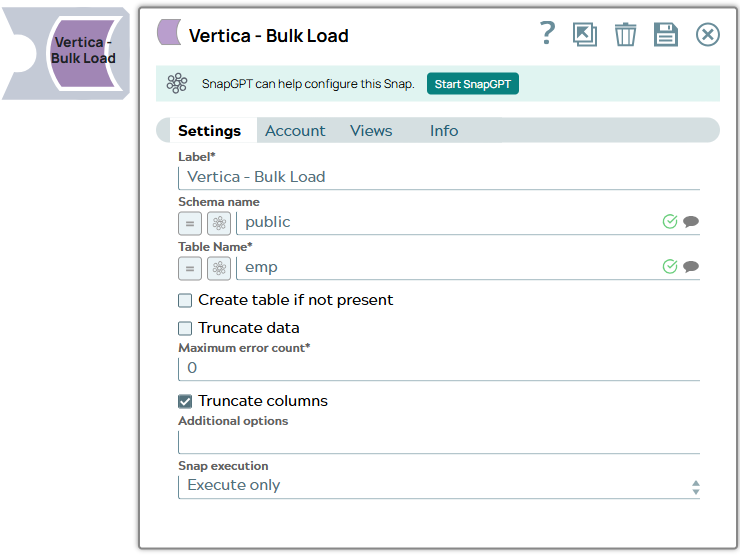
| Label
|
Specify a unique name for the Snap. Modify this to be more appropriate, especially if more than one of the same Snaps is in the pipeline. Default value: Vertica Bulk Load Example: Vertica Bulk Load |
| Schema name
|
Required. Specify the
database schema name. Selecting a schema filters the Table name list to show
only those tables within the selected schema. The property is suggestible and
retrieves available database schemas during suggest values. Note: You can pass the
values using Pipeline parameters but not upstream parameters. Default value: N/A Example: public |
| Table name
|
Required. Specify the table
on which to execute the bulk load operation. Note: The values can be passed using the
pipeline parameters but not the upstream parameter. Default value: N/A Example: emp |
| Create table if not present
|
Select this check box to automatically create the
target table if it does not exist. This Snap creates a table based on the data types
of the columns generated from the first row of the input document. Note: Due to
implementation details, a newly created table is not visible to subsequent
database Snaps during runtime validation. If you wish to immediately use the newly
updated data you must use a child Pipeline that is invoked through a Pipeline
Execute Snap. Default value: Not selected |
| Truncate data
|
Truncate the existing data before performing the
data load. With the Bulk Update Snap, instead of executing truncate and then update,
using a Bulk Insert Snap would be faster. Default value: Not selected |
| Maximum error count
|
Specify the maximum number of rows that can fail
before the bulk load operation is stopped. Default value: 0 Example: 10 |
| Truncate columns
|
Truncate column values that are larger than the
maximum column length in the table. Default value: Selected |
| Additional options
|
Additional options to be passed to the COPY
command. See Copy Parameters for the available options. Default value: N/A |
| Snap Execution
|
Choose one of the three modes in which the Snap executes. The available options are: Validate & Execute: Performs limited execution of the Snap and generates a data preview during pipeline validation. Subsequently, performs full execution of the Snap (unlimited records) during pipeline runtime. Execute only: Performs full execution of the Snap during pipeline execution without generating preview data. Disabled: Disables the Snap and all Snaps that are downstream from it. Default value: Execute only Example: Validate & Execute |
We recommend you to use Vertica - Multi Execute Snap, instead of building multiple Snaps with inter dependent DML queries.
In a scenario where the downstream Snap depends on the data processed on an upstream Database Bulk Load Snap, use the Script Snap to add delay for the data to be available.
For example, when performing a create, insert and a delete function sequentially on a Pipeline using a Script Snap helps in creating a delay between the insert and delete function or otherwise it may so happen that the delete function is triggered even before inserting the records on the table.
Temporary Files
The Snap uses temporary files to improve performance. For details about temporary files, see Temporary Files.