


DynamoDB Update
Overview
The DynamoDB Update Snap updates data in a DynamoDB table.
Supported Accounts
- This is a Write-type Snap.
 Works in Ultra Tasks
Prerequisites
None.
Snap views
| Type | Description | Examples of upstream and downstream Snaps |
|---|---|---|
| Input |
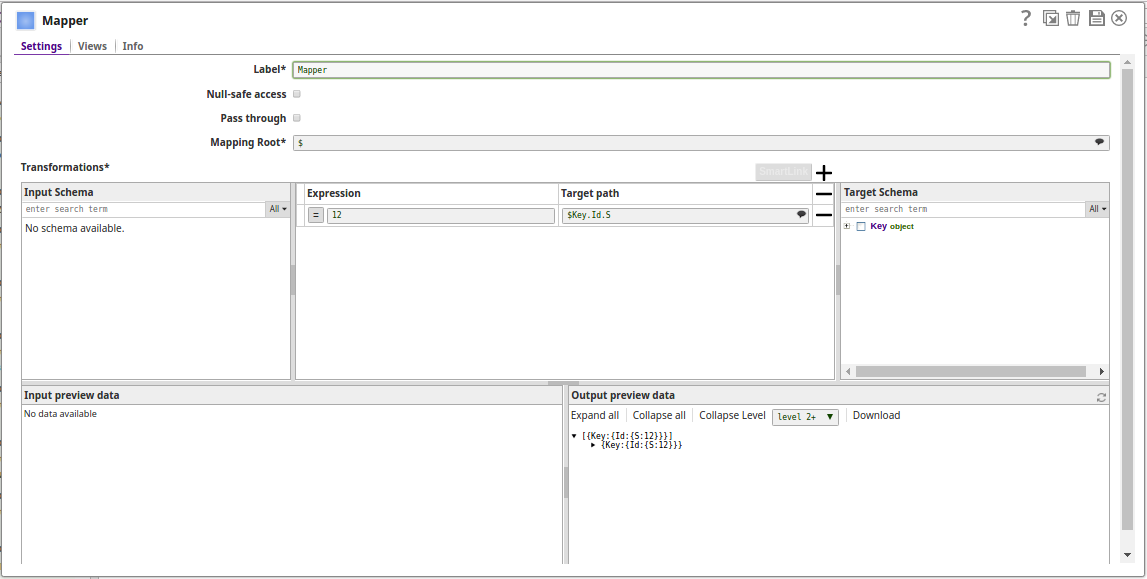
This Snap has exactly one document input view. Expected input: The table's key schema is suggested on input view. The attribute values for the attributes of the key of the record are passed from input view. |
|
| Output |
This Snap has exactly one document output view. Expected output: This Snap provides the updated record for each input record. Errors can be routed to the error view if enabled or cause the Snap to fail during execution. |
|
| Learn more about Error handling. | ||
Snap settings
| Field/Field set | Description |
|---|---|
|
Label String
|
Specify a unique name for the Snap. Modify this to
be more appropriate, especially if there are more than one of the same Snap in the
pipeline.
Default value: DynamoDB Update |
|
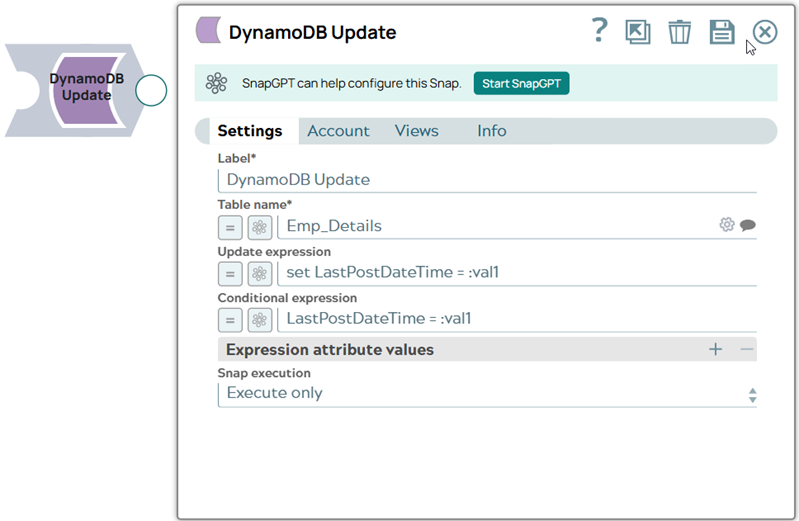
Table name String/Expression/ Suggestion
|
Required. The name of the table to write the data into. This
property is suggestible, which shows the list of the tables in the database. Default value: None Example: Thread |
|
Update expression String/Expression
|
An expression that defines one or more attributes to be updated. Default value: None Example:
|
|
Conditional expression String/Expression
|
A condition that must be satisfied in order for the update to succeed. Default value: None Example:
|
|
Expression attribute values |
Specify the placeholders for the Expression Attribute Names and/or Expression Attribute Values. Example: If your table contains a column named UUID (a
reserved word) and you want to update a value in the UUID column, then you must
assign a placeholder for the column name because you cannot use a reserved word
directly in your expression. You can define the Attribute
#u, leave the Type blank, and enter
the value as UUID. In the Snap Update
expression condition, enter Set #u=:val1.
Note: DynamoDB reserves certain words and they are called reserved words. You must
not use reserved words as attribute names in expressions. If you must write an
expression that contains a word that conflicts with a DynamoDB reserved word, then
you can define an expression attribute name to use in the place of the reserved
word. For more information, see Expression Attribute Names. Similarly, you
cannot use certain values as attribute values in expressions and instead must
define an expression attribute name. For more information, see Expression Attribute Values.
|
Attribute
String/Expression |
The expression attribute name. Begins with a # for names and : for values.
Default value: None Example: |
Type
String/Expression |
The attribute type. Blank for Expression Attribute Names. S for string, N for number, and so on, for Values.
Default value: None Example: |
Value
String/Expression |
The actual literal to be used in the update condition.
Default value: None Example: |
|
Snap execution Dropdown list
|
Choose one of the three modes in
which the Snap executes. Available options are:
Default value: Execute only |
DynamoDB complex types
DynamoDB supports the following complex types:
| Sets |
String Set [SS] |
A values of this type contains a set of strings delimited by double quotes as follows: Pattern: [String object 1, String object 2, ........, String Object n] Example: ["Snaplogic", "San Mateo", "Pipeline"] |
|
Number Set [NS] |
A value of this type contains a set of numbers delimited by double quotes as follows: Pattern: [Number Obj1, Number Object2,...., Number Object n] Example: ["123", "24.56", "-35", "-21.456","0"] |
|
|
Binary Set [BS] |
A value of this type contains a set of base64-encoded binary data objects delimited by double quotes as follows: Pattern: [ Binary Object 1, Binary Object 2,...Binary Object n] Example: ["U3Vubnk=", "UmFpbnk=", "U25vd3k="] |
|
|
List (L) |
A value of this type contains a set of objects. Each object further can be of any type (String, Number, String Set, Map, List etc.,). In general, the List object resembles a JSON array. Pattern: [ object 1, object 2, ........, Object n] Example: [{"N":"3"},{"S":"-7.5"},{"B":"U3Vubnk="},{"L":[{"N":"-45.56"},{"M":{"Name":{"S":"ahmed"}}}]}, {"M":{"name":{"S":"syed"}}},{"SS":["a","b"]},{"BS":["U3Vubnk="]},{"NS":["23","45"]}] |
|
|
Map (M) |
A value of this type contains a set of key-value pairs. Keys are always strings, whereas values can be of any type (String, Number, String Set, Map, List etc.,). In general, the Map object resembles a JSON array. Pattern: {"Key1":Object1, "Key2": Object2......"Keyn": Objectn} Example: {"id":{"S":"snaplogic"}, "orgs":{"L":[{"S":"uat"}, {"S":"qa"}]}, "admins":{"L":[{"M":{"name":{"S":"a"}}}, {"M":{"name":{"S":"45"}}}]}} |
|
|
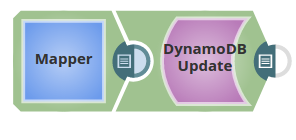
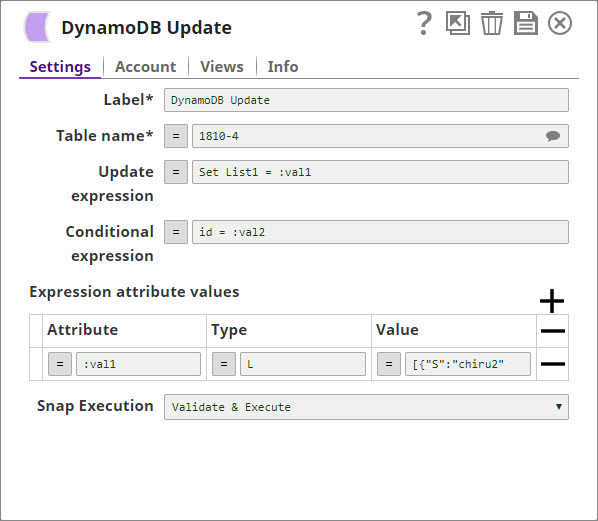
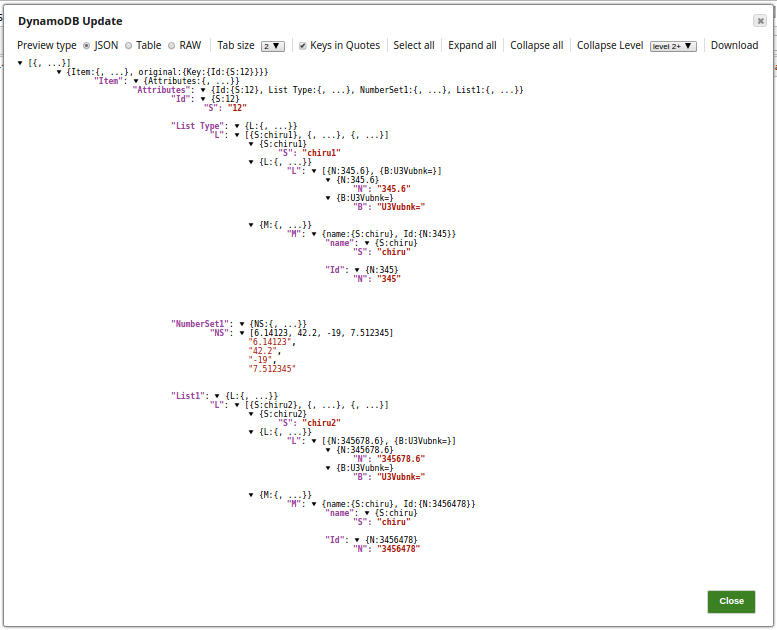
The pipeline using all the Set types for the Update Snap: |
 |
|
   |
||