


Oracle - Insert
Overview
The Oracle - Insert Snap executes an SQL Insert statement.
Document keys are used as the columns to insert into, and their values are inserted into the column. Any missing column will insert a null value into it.
The Oracle JDBC Driver is upgraded from OJDBC6 JAR (v11.2.0.4) to OJDBC10 JAR (v19.20.0.0) in the latest distribution in October 2023 and deployed to the stable distribution in the November 2023 release (after the Snaplex upgrade). The latest JDBC driver upgrade is backward-compatible. Learn more: Oracle JDBC driver and JOOQ upgrades.
You can consume this driver upgrade with the 434patches23000 Snap Pack
version.
This JDBC driver upgrade has resulted in specific behavior changes that include errors, status codes, and success and failure messages. Learn more about the behavior changes to ensure your migration to the upgraded driver is seamless.
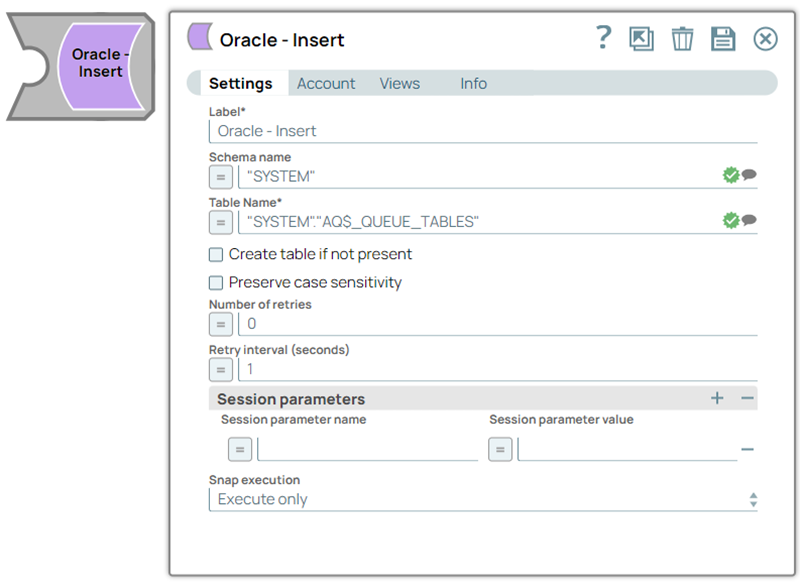
- This is a Write-type Snap.
 Works in Ultra Tasks when the Batch size is set to 1.
Prerequisites
- A valid Oracle Thin Account or Oracle Thin Dynamic Account.
Known issues
The Oracle - Insert Snap inserts incorrect time zone data for timestamp with time zone data
type. For example, when an input value is 2021-08-10 17:30:43-07:00, the
value written to the target table is 2021-08-10 17:30:43+07:00.
Workaround: Use an expression Date.parse(2021-08-10 17:30:43-07:00)
in Mapper Snap. The Mapper Snap converts it to a UTC timestamp string, that is,
2021-08-11 00:30:43 00:00. The Snap will now insert the value
successfully.
Snap views
| Type | Description | Examples of upstream and downstream Snaps |
|---|---|---|
| Input |
This Snap has at least one document input view (Min: 1, Max: 2). Requires the Schema name and Table name to process a certain number of input documents into a prepared insert query. The second input view can be added for metadata for the table as a document so that the table is created in Oracle with a similar schema as the source table. If the table already exists, then the metadata is not used. |
|
| Output |
This Snap has at most one document output view (Min: 0, Max: 1). Snap outputs the number of documents successfully inserted into the target table in the output view document. |
|
| Learn more about Error handling. | ||
Snap settings
- Expression icon (
 ): Allows using
pipeline parameters to set field values dynamically (if enabled). SnapLogic Expressions
are not supported. If disabled, you can provide a static value.
): Allows using
pipeline parameters to set field values dynamically (if enabled). SnapLogic Expressions
are not supported. If disabled, you can provide a static value. - SnapGPT (
 ): Generates SnapLogic Expressions
based on natural language using SnapGPT. Learn
more.
): Generates SnapLogic Expressions
based on natural language using SnapGPT. Learn
more. - Suggestion icon (
 ): Populates a
list of values dynamically based on your Snap configuration. You can select only one
attribute at a time using the icon. Type into the field if it supports a comma-separated
list of values.
): Populates a
list of values dynamically based on your Snap configuration. You can select only one
attribute at a time using the icon. Type into the field if it supports a comma-separated
list of values. - Upload
 : Uploads files. Learn more.
| Field/Field set | Description |
|---|---|
Label* String |
Specify a unique name for the Snap. Modify this to be more appropriate, especially if more than one of the same Snaps is in the pipeline. Default value: Oracle - Insert Example: Insert Emp data |
Schema name
String/Expression/ Suggestion |
Specify the database schema name. The suggestions in the Schema field are
populated only when at least a single table exists in the schema. If no tables exist
to use that schema, only SYS, SYSTEM, and XDB are populated.
Default value: N/A Example: SYS |
Table Name*
String/Expression/ Suggestion |
Required. Specify the table that the rows will be inserted into. This list is populated
based on the tables associated with the selected schema. Default value: N/A Example: people |
Create table if not present
Checkbox |
Select this checkbox to automatically create the target table if it does not
exist.
Due to implementation details, a newly created table is not visible to subsequent database Snaps during runtime validation. If you want to immediately use the newly updated data you must use a child Pipeline that is invoked through a Pipeline Execute Snap. Learn more about table creation. Default value: Deselected |
Preserve case sensitivity
Checkbox |
Select this checkbox to preserve the case sensitivity of the column names while
performing the insert operation.
|
Number of retries
Integer/Expression |
Specify the maximum number of attempts to be made to receive a response. The
request is terminated if the attempts do not result in a response. Default value: 0 Example: 3 |
Retry interval (seconds)
Integer/Expression |
Specify the time interval between two successive retry requests. A retry
happens only when the previous attempt resulted in an exception. Default value: 1 Example: 10 |
| Session parameters | Use this field set to define the session
parameters. This property lets you use the National Language Support (NLS)
parameters. See the Oracle documentation for detailed information about Setting NLS Parameters. The NLS parameters enable overriding the default value (e.g., a comma) that is set for the session in the initialization parameter file or set by the client with environment variables (e.g., a decimal point). You can add multiple parameters by using the plus (+) sign next to Session parameters. |
Session parameter name
String/Expression |
Specify the session parameter name. Default value: N/A Example: NLS_TERRITORY |
Session parameter value
String/Expression |
Specify the session parameter value. Default value: N/A Example: "CZECH REPUBLIC" |
Session parameter type
Dropdown list |
Select the data type of the session parameter value. The Snap validates the
value against the selected type before it runs the
If the value does not match the selected type, the Snap displays a configuration error. Default value: STRING Example: INTEGER |
|
Snap execution Dropdown list
|
Choose one of the three modes in
which the Snap executes. Available options are:
Default value: Execute only Example: Validate & execute |
Auto commit
In a scenario where the Auto commit on the account is set to true, and the downstream Snap depends on the data processed on an upstream Database Bulk Load Snap, use the Script Snap to add delay for the data to be available.
For example, when performing a create, insert, and a delete function sequentially on a pipeline, using a Script Snap helps in creating a delay between the insert and delete function or otherwise it may turn out that the delete function is triggered even before inserting the records on the table.
Oracle reports failures for the entire batch even if some rows successfully inserted/updated. Because the Snap must report what is reported by the database, the Snap sends all records to the error view and no record to the output view. If you want to see accurate results for each row you must set the batch size to 1 and execute the pipeline.