


Path resolution
How APIM 3.0 resolves the path forwarded to a native or external endpoint.
The endpoint path enables APIM 3.0 to route and resolve requests. In endpoint configuration, the Routing method section includes a Path field.
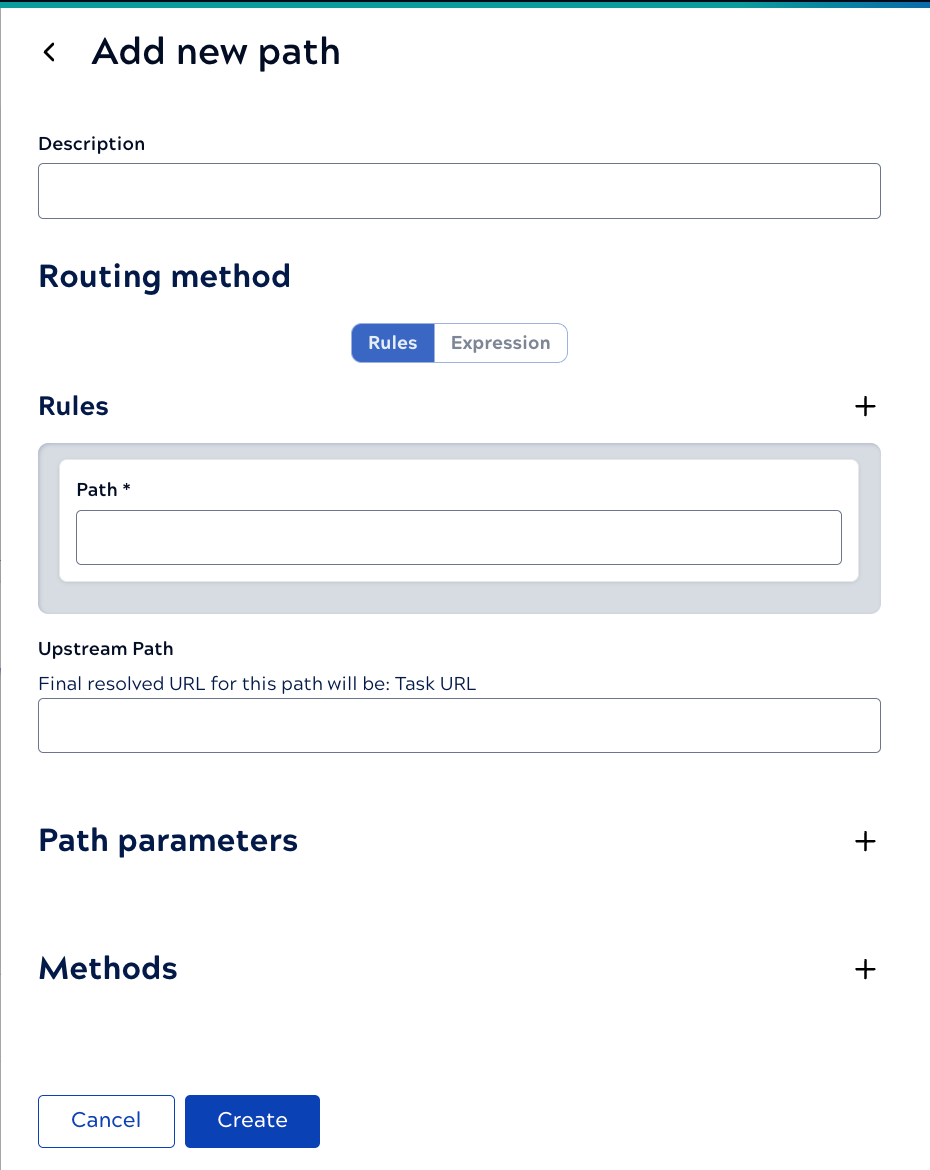
Select Rules or Expression, then enter the Path. Rules is the default and is all you need for basic routing.
When two endpoints share the same path, use rules or expressions to determine which endpoint handles a given request — for example, routing US-locale traffic to one endpoint and EMEA-locale traffic to another. Use:
- Rules when the match condition is one or more name-value pairs, such as a required header or query parameter value.
- Expressions when the match condition needs arbitrary boolean logic across the request.
Both rules and expressions have a Path field and an optional Upstream Path field:
- Path: Required. A pattern that incoming requests must match. Path
parameters are named variable segments of the URL — enclose them in curly braces to
capture their values. For example, in
/orders/{orderId},{orderId}captures42from a request to/orders/42. - Upstream Path: Optional. Shapes the path that APIM 3.0 forwards after matching the request. It is a template
that APIM 3.0 fills in with path-parameter values from the
incoming request. For native endpoints, it controls the
PATH_INFOvalue the pipeline receives. For external endpoints, it shapes the path appended to the Upstream URL. For example, you can expose/orders/{orderId}to clients while forwarding a different path to the upstream destination.
At runtime, these field values have different uses for the two types of endpoints:
- For a native endpoint (a Triggered Task or Ultra Task pipeline):
- If Upstream Path is empty, APIM 3.0 resolves the endpoint Path (substituting path-parameter
values) and sends it as
PATH_INFO. This behavior requires release 4.45 or later. - If Upstream Path is populated, APIM 3.0 resolves the Upstream Path
(substituting path-parameter values) and sends it as
PATH_INFOinstead.
Refer to Pass pipeline arguments to Triggered Task for details on reading
PATH_INFOin a pipeline. - If Upstream Path is empty, APIM 3.0 resolves the endpoint Path (substituting path-parameter
values) and sends it as
- For an external endpoint (one proxied to a third-party server):
APIM 3.0 concatenates the endpoint's Upstream
URL with the Upstream Path (after substituting path
parameters) and sends the outbound URL to the third-party server. For example, with
Upstream URL
https://api.github.com/repos/acme/widgetsand Upstream Path/issues/{issueId}, APIM 3.0 forwards a request to/issues/42ashttps://api.github.com/repos/acme/widgets/issues/42.
If the incoming request includes path segments beyond the matched route, APIM 3.0 appends
those trailing segments to the resolved path. For example, a request to
/orders/42/items/9 matched against route /orders/{orderId}
captures orderId=42 and treats /items/9 as trailing segments,
which APIM 3.0 appends after substitution.
Empty Upstream Path
When Upstream Path is empty, behavior depends on the endpoint type:
- For a native endpoint (Triggered Task or Ultra Task), APIM 3.0 resolves the endpoint
Path (substituting path-parameter values) and sends it as
PATH_INFO. This is the default behavior as of release 4.45 — you only need to populate Upstream Path when the pipeline should receive a different path than the one matched. - For an external endpoint, APIM 3.0 sends the request to the
endpoint's Upstream URL and appends any trailing request segments.
APIM 3.0 does not substitute the route
Path into the outbound URL. For example, if
Upstream URL is
https://api.github.com/repos/acme/widgets/issues, Path is/issues, and Upstream Path is empty, APIM 3.0 forwards a request to/issues/42ashttps://api.github.com/repos/acme/widgets/issues/42. Only the trailing/42is appended; the matched Path/issuesis not part of the outbound URL.
Migrating from APIM Classic
If you're not migrating from APIM Classic, you can skip this section.
APIM Classic (Proxies) and APIM 3.0 use different constructs for conditional routing:
- In Classic APIM Manager, each Mapping Rule has conditions that determine when it applies and a Target URL that determines what reaches the upstream.
- In APIM 3.0, advanced routing — Rules or Expression — lives inside an endpoint Path. Migrating a Proxy with Mapping Rules adds the equivalent Rules or Expression on the corresponding Path.
Mapping expressions in Classic often reference path segments by
position, such as request.uri.pathSegments[3]. These references can behave
unexpectedly after migration because for native endpoints, the path that reaches the pipeline
is now PATH_INFO, derived from the endpoint Path
(or Upstream Path, if set).
Refer to Move from Classic APIM to APIM 3.0 for migration considerations.